
Networks, fees and status
Collected straight from the exchange. The fee is quoted in the coin itself and does not depend on the amount — splitting a withdrawal into parts only costs more.
What OKX is
OKX has been running since 2017 and belongs to the small group of exchanges with a complete derivatives set: not only perpetual futures, but dated ones and options too. This is a venue for people who have outgrown simply buying bitcoin.
Its second distinction is a full Web3 ecosystem. A wallet, access to decentralised exchanges and its own X Layer network are built into the same app, so you never switch between exchange and wallet.
What you get here
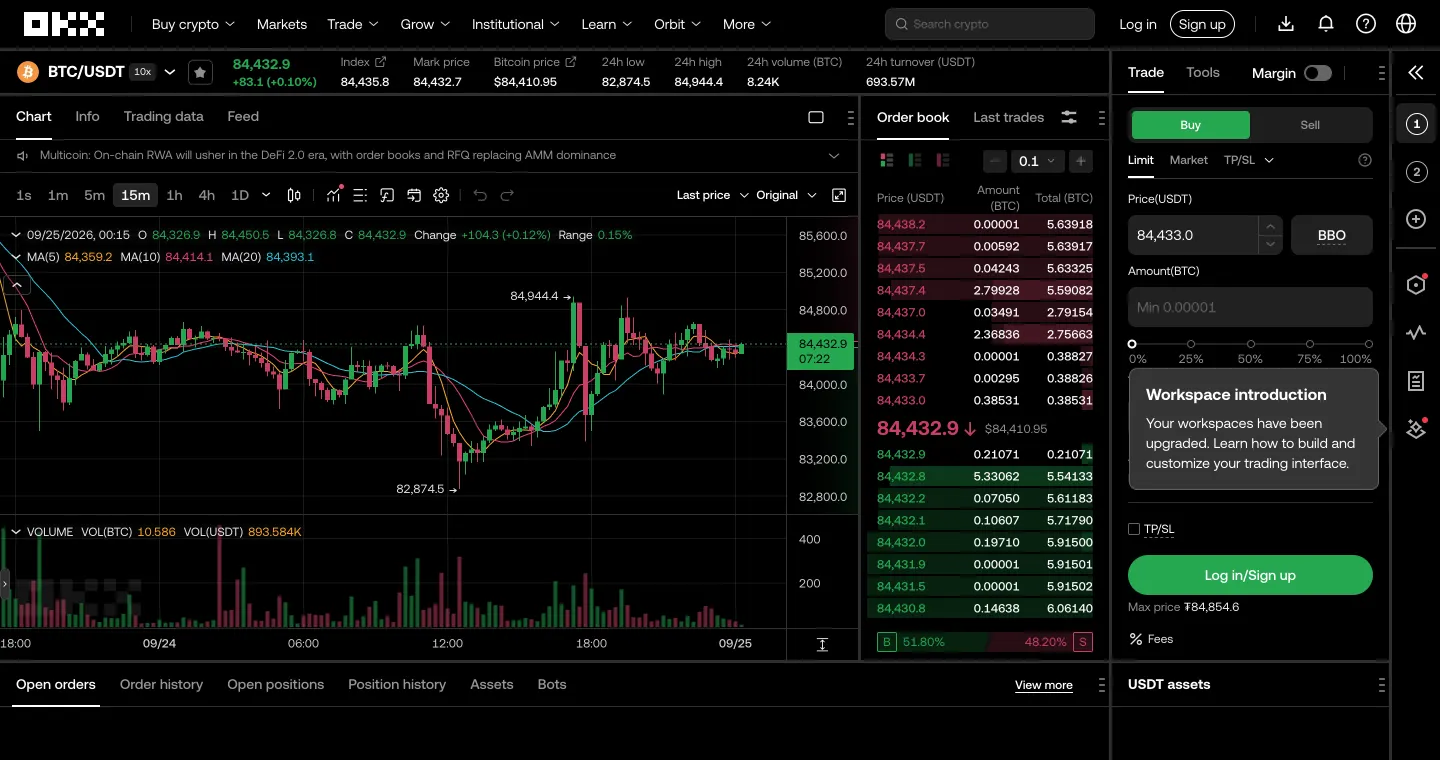
Spot — over four hundred USDT pairs, plus two hundred and seventy-two pairs quoted directly in euro: second only to Kraken in our review on that count.
Futures — perpetual and dated, almost five hundred contracts.
Options — a proper section, not a formality.
P2P — crypto for ordinary money straight from people, with the exchange in escrow.
Earn — savings, staking, dual investments and structured products.
Jumpstart — take part in new token launches.
Copy trading and bots — mirror other traders or run automated strategies.
Web3 wallet — non-custodial, with access to decentralised exchanges and apps from the same interface.
Buying one coin for another or for USDT: plain trading, no leverage and no expiry.
475 pairsLeveraged contracts with no expiry date. Funding is charged every few hours — you either pay it or receive it.
528 contractsBuying crypto for ordinary money straight from people; the venue holds the coins in escrow until payment is confirmed.
30 currenciesRare among venues. They cap the loss up front: you pay a premium and get a right, not an obligation.
Yield on coins that just sit there: flexible, withdrawable at any moment, or locked for a term at a higher rate.
Mirroring a chosen trader's deals: their statistics are public and the position size scales to your capital.
Grid trading and averaging configured right in the interface, with no code and no third-party service.
Paying for purchases from a crypto balance wherever ordinary cards are accepted.
Fees and where the real saving is
Entry level is a tenth of a percent for takers and slightly less for makers, falling with volume and with OKB held on the balance.
The main saving here is not the trading fee but the transfers: OKX runs its own X Layer network, and USDT withdrawals there are free. Sixteen networks in total. If you move coins often, that detail matters more than a couple of hundredths of a percent per trade.
Deposits and withdrawals
P2P works the usual way: pick an offer, send the payment, the crypto is released from escrow.
Current network fees are in the live table at the top of this page — we collect them straight from the exchange.
Fund through P2P the usual way in
Withdraw over a network the price depends on the network
This is where most money is lost to carelessness: the transfer price depends on the network, not on the amount.
Schedules: global, European and contract
In the standard global group an ordinary user pays 0.080% maker and 0.100% taker. The tiers take it down from there: 0.0675% and 0.080% at the first, 0.060% and 0.070% at the second, 0.055% and 0.065% at the third, and lower again from the fourth to the ninth.
| Tier | Maker | Taker |
|---|---|---|
| Regular | 0.08% | 0.1% |
| VIP 1 | 0.0675% | 0.08% |
| VIP 2 | 0.06% | 0.07% |
| VIP 3 | 0.055% | 0.065% |
Rates as published by the exchange on the check date; the tier is recalculated automatically. The standard global group of spot pairs; tiers four to nine fall further. Accounts in the European Economic Area run on a separate grid.
For spot-only accounts in the European Economic Area, a separate grid applies after the change of 25 September 2026: 0.100% maker and 0.200% taker on ordinary pairs, and zero maker with 0.050% taker on stablecoin pairs. The global rate cannot be carried over to a European account: the taker fee there is twice as high. Rates also differ for accounts with derivatives enabled.
Contracts run their own, noticeably lower, schedule.
| Tier | Maker | Taker |
|---|---|---|
| Regular | 0.020% | 0.050% |
| VIP 1 | 0.016% | 0.045% |
| VIP 2 | 0.015% | 0.036% |
| VIP 3 | 0.010% | 0.028% |
| VIP 4 | 0.008% | 0.027% |
| VIP 5 | 0.005% | 0.026% |
| VIP 6 | 0% | 0.025% |
| VIP 7 | −0.002% | 0.020% |
| VIP 8 | −0.0025% | 0.020% |
| VIP 9 | −0.005% | 0.015% |
The standard global contract group. From the seventh tier the maker fee turns negative — a rebate for adding liquidity, not an error in the table.
On contracts the fee is charged twice: on open and on close. A 10,000 USDT position at the 0.05% taker rate costs 5 USDT going in and 5 coming out — ten dollars for a full turn, with funding outside that sum.
Order minimums and the instrument directory
There is no single minimum: each pair has its own minSz (minimum size), lotSz (quantity step) and tickSz (price step). They come from the directory at okx.com/api/v5/public/instruments with the SPOT, SWAP, FUTURES or OPTION type.
One subtlety: on spot the minimum is in the base currency, on contracts it is a number of contracts. The two cannot be compared directly; to get a cash notional, multiply the minimum by the contract value and the price.
Derivatives: six kinds and margin in three currencies
There are perpetual swaps, dated futures with an expiry, contracts margined in USDT, in USDC and in the coin itself, plus options with calls and puts across strikes and expiries. Position modes are net and separate long/short, with availability depending on the instrument and account settings.
No single maximum leverage applies: it depends on the instrument, the pair, the position size, the risk limit, the margin mode and the region. And this matters: for European X-Perps the help states leverage up to 10x — an order of magnitude below the global derivatives. The regional product and the global one are not the same thing.
Spot margin trading runs separately with cross and isolated modes: borrow an asset, open a short, raise exposure. Interest on the loan is a separate cost and is not part of the trading fee.
P2P with no platform fee
The mechanics are standard: the seller's coin is escrowed, the buyer pays directly, the seller confirms and the coin moves. There are merchants, appeals, and one rule worth remembering: the payment account must be yours and verified — paying from someone else's details is against the rules.
OKX charges nothing of its own on a P2P trade — zero percent. But that is the platform's fee, not the cost of the transfer: the bank, the wallet or the payment system will take theirs.
Fiat deposits do not work everywhere. In the European Economic Area, SEPA and SEPA Instant are available for the euro. For the dollar there are separate routes including domestic wire and ACH, and the help gives a 30 USD fee on a domestic wire withdrawal — one specific route, not a general rule for all dollar operations.
Deposits, withdrawals, and reading networks programmatically
The venue charges nothing of its own to credit crypto. The minimum and confirmation count depend on the coin and network, and some assets — XRP, XLM and others — need a memo or tag. The network list is long: Bitcoin, Ethereum, TRON, BSC, Solana, Arbitrum, Optimism, Polygon, Avalanche, Base, TON, XRP Ledger, Litecoin, Bitcoin Cash, Dogecoin, Aptos, Sui and more, with a different set for every token.
For automation, okx.com/api/v5/asset/currencies is the useful one: per currency and network it returns whether deposits and withdrawals are open, the minimums and the fee bounds. That is exactly the source to build a route table from, rather than maintaining one by hand.
Withdrawals go to an external address or as an internal transfer between OKX accounts — the internal route skips the blockchain and the usual wait. Before sending, check the address, network, memo, minimum, fee and network status: a chain can be closed temporarily for maintenance.
Earn, copy trading and bots
Earn gathers simple placement in flexible and fixed form, on-chain yield through staking and DeFi, dual investment and structured products. There is no universal rate: it depends on the asset, the term, the size, demand and the product itself. And not every product preserves the principal — dual investment returns the money in whichever asset the market settles on.
We use the exchange's own formula: amount × rate ÷ 365 × term. Put in the rate you see in your account — it changes.
Copy trading lets you pick a trader, read their return and result, and set the amount and risk parameters. Bots are a separate section; as everywhere, a bot's trades pay the ordinary fee, with funding on top on contracts.
Convert, the card and payments
Convert swaps one coin for another with no order in the book: you see a quote and confirm. Mind the spread and the size limits — no separate fee is not the same as a one-to-one rate.
The card and OKX Pay work in selected regions; availability, fees and limits depend on the programme and the country and need checking in your own account.
The API
The venue runs a single v5 interface: public data, accounts, trading, funding and WebSocket. Two methods are worth knowing for anyone automating: /api/v5/public/instruments for instrument parameters and /api/v5/asset/currencies for networks, minimums and fees. The first saves you from rejected orders, the second from sending into a closed network.
Who it suits
People who need options and dated futures, which few venues offer. People working with both centralised and decentralised markets, since this is one window for both. And anyone counting in euro: two hundred and seventy-two direct pairs remove the extra hop through USDT.
Frequently asked
What does trading on OKX cost?+
In the standard global group, 0.080% maker and 0.100% taker, and 0.020% and 0.050% on contracts. The rate falls with the tier, and from the seventh the contract maker fee turns negative — the venue rebates part of the fee for adding liquidity.
Why is my fee higher than the table?+
Most likely the account sits in the European Economic Area. European spot accounts run a separate grid: 0.100% maker and 0.200% taker on ordinary pairs, with a zero maker fee on stablecoin pairs.
What is the minimum order on OKX?+
Each pair has its own: minSz, lotSz and tickSz come from the directory at okx.com/api/v5/public/instruments. On spot the minimum is in the base currency and on contracts in contracts, so the two cannot be compared directly.
What does P2P cost on OKX?+
The venue charges nothing — zero percent. Costs arise with the bank, the wallet or the payment system. Payment must come from your own verified details.
What leverage does OKX offer?+
There is no single maximum: it depends on the instrument, the position size, the risk limit and the region. For European X-Perps the help states up to 10x — far less than the global derivatives.
How does OKX differ from Binance?+
Books are nearly as deep, trading pairs are often more numerous, and the app contains a non-custodial wallet with a DEX aggregator — a combination Binance does not offer.
What is the separate European domain?+
Users in the European Economic Area are served by a separate legal entity on its own domain. Accounts and API keys do not carry across.
Is the built-in Web3 wallet safe?+
It is non-custodial: the keys are yours, the exchange has no access and cannot recover funds. Its safety equals how well you keep the recovery phrase.
Is there P2P?+
Yes, and it is among the strongest for CIS currencies and the Turkish lira.
Methodology and principles of analytical processing
Forming and structuring the data
The analytical system brings disparate market information together into a single structure, accounting for the specifics of trading directions and the individual characteristics of each platform. That keeps the presentation consistent and the key parameters comparable.
Criteria for forming the results
Forming the analytical selection takes into account the completeness, availability and reliability of the source information. Parameters that meet the established processing and confirmation criteria are included in the calculations. Insufficiently substantiated values are not used in the final results.
Currency of the analytical information
The information presented is kept current through regular refreshing and reconciliation of the analytical parameters. How often that happens is determined by the nature of each category of data and the way it is processed.
OKX or another exchange

Two venues with genuinely deep books. A look at what each one does and why people keep both.
Compare
The best derivatives terminal against the most complete ecosystem. A feature-by-feature look at where the line falls.
Compare
A dense book and a Web3 wallet against a zero maker fee and coins before everyone else. A look at which matters more in your case.
Compare
OKX and Bitget are two ecosystems of the same class. The choice usually turns on a detail: withdrawal price, interface, or a coin the other one lacks.
Compare
For a rare coin go to Gate; for bots and earn go to OKX. They overlap less than it looks.
Compare
OKX and KuCoin are two ecosystems of the same class. The choice usually turns on a detail: withdrawal price, interface, or a coin the other one lacks.
Compare
OKX and HTX are built alike: spot, futures, earn, bots. The difference is in the emphasis and shows only up close.
Compare
A terminal against an ecosystem: BingX is stronger at trading itself, OKX at everything around it.
Compare
WEEX is built for contracts; OKX also covers earn, bots and launches. It comes down to what you need more often.
Compare
Toobit is built for contracts; OKX also covers earn, bots and launches. It comes down to what you need more often.
Compare
LBank wins on the breadth of the list, OKX on the services around trading. People often keep both and switch by task.
Compare
OKX is more interesting inside crypto, Kraken at the way in and out, where euro and dollar stay themselves.
Compare
OKX is more interesting inside crypto, WhiteBIT at the way in and out, where euro and dollar stay themselves.
Compare
Phemex is built for contracts; OKX also covers earn, bots and launches. It comes down to what you need more often.
Compare
OKX and XT.com are built alike: spot, futures, earn, bots. The difference is in the emphasis and shows only up close.
Compare
OKX and KCEX are two ecosystems of the same class. The choice usually turns on a detail: withdrawal price, interface, or a coin the other one lacks.
Compare
OKX and Ourbit are two ecosystems of the same class. The choice usually turns on a detail: withdrawal price, interface, or a coin the other one lacks.
Compare
OKX and BigONE are built alike: spot, futures, earn, bots. The difference is in the emphasis and shows only up close.
Compare
OKX and Crypto.com are built alike: spot, futures, earn, bots. The difference is in the emphasis and shows only up close.
Compare
OKX and Hotcoin are built alike: spot, futures, earn, bots. The difference is in the emphasis and shows only up close.
Compare
OKX and Pionex are two ecosystems of the same class. The choice usually turns on a detail: withdrawal price, interface, or a coin the other one lacks.
Compare
OKX and HIBT are two ecosystems of the same class. The choice usually turns on a detail: withdrawal price, interface, or a coin the other one lacks.
Compare
OKX and Zoomex are built alike: spot, futures, earn, bots. The difference is in the emphasis and shows only up close.
Compare
OKX and Bitunix are two ecosystems of the same class. The choice usually turns on a detail: withdrawal price, interface, or a coin the other one lacks.
Compare
OKX and xRocket are built alike: spot, futures, earn, bots. The difference is in the emphasis and shows only up close.
Compare
A terminal against an ecosystem: BloFin is stronger at trading itself, OKX at everything around it.
Compare
A terminal against an ecosystem: CoinW is stronger at trading itself, OKX at everything around it.
Compare

OKX in our scanners: the spot spread, the futures gap, funding rates, P2P rates.
Other exchanges
The venue where new coins appear first and the spot maker fee is zero. Here is who benefits from that.
Read the reviewThe venue with three free trading bots built into the interface — you can automate a strategy here without a single line of code.
Read the reviewThe widest spot listing in our review and the largest copy-trading venue. Here is what it offers and who it suits.
Read the reviewAn exchange running since 2013 with the widest choice of USDT withdrawal networks of any venue in our review.
Read the reviewVenue names on this page link to the exchanges through affiliate links: if you sign up through them, we earn a commission from the exchange. It changes nothing in the tables or in the review — those are collected automatically and identically for every venue.