
Networks, fees and status
Collected straight from the exchange. The fee is quoted in the coin itself and does not depend on the amount — splitting a withdrawal into parts only costs more.
What BigONE is
BigONE has been running since 2017, making it one of the oldest venues in this comparison. Its team came out of the Yunbi exchange — deep history by the industry's standards.
By our measurements it carries around nine hundred spot pairs and a hundred perpetual contracts. Smaller than the giants, but the data is fully open: every pair arrives with not just the best prices but the size behind them, and every contract with its funding rate, accrual interval and mark price.
What is on offer
Spot — around nine hundred pairs, mostly against USDT.
Futures — a hundred perpetual contracts, each with its own rate.
Margin and leveraged tokens — borrowed-funds trading and ready-made leveraged instruments.
Staking — putting coins to work at a yield.
The ONE token — the venue's own token, discounting fees.
The thing to know: a thin top of book
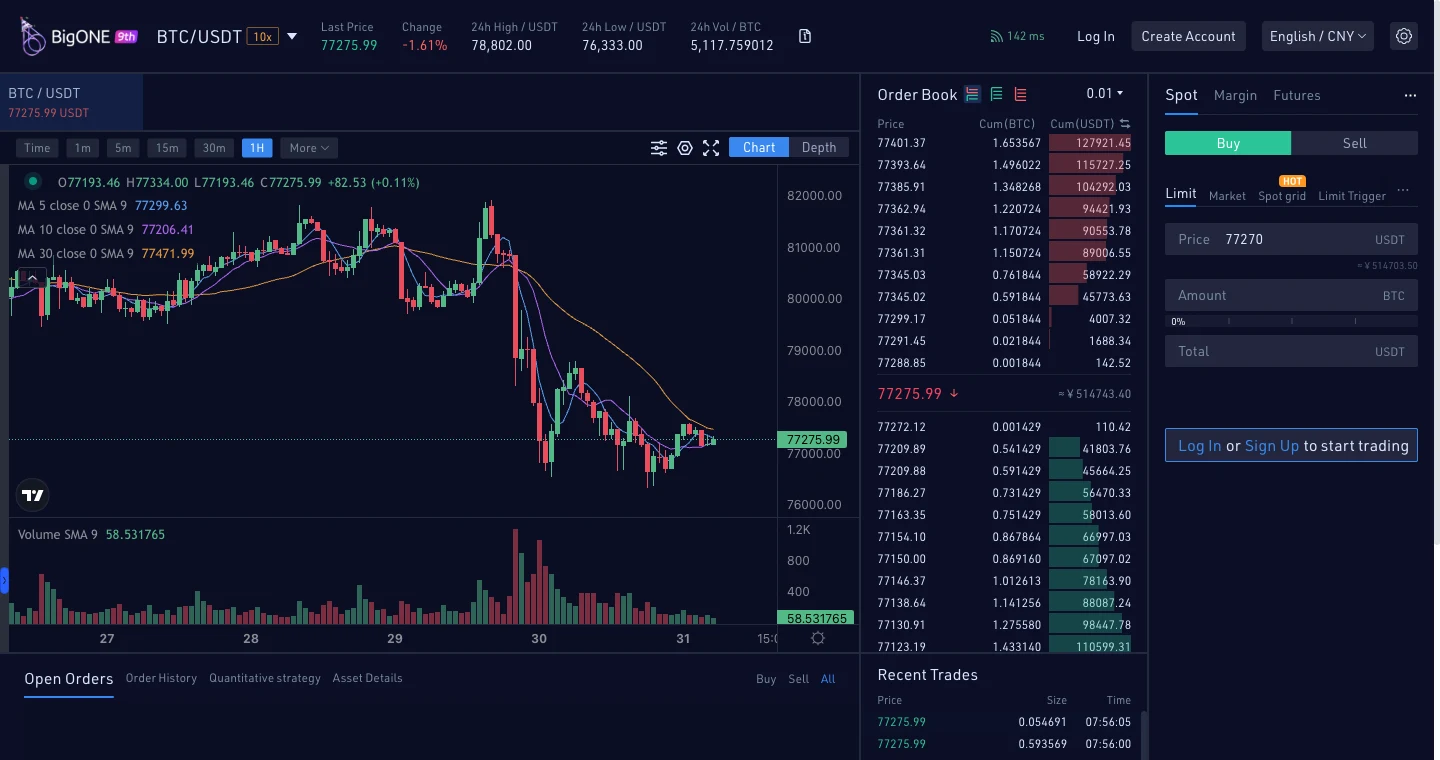
This is not nitpicking — it decides whether a route works. The size at the best price on BigONE is often measured in hundreds of dollars even for bitcoin: at the time of writing the best bid held about 0.0014 BTC, roughly a hundred and ten dollars. A spread can look inviting on screen and still fill only for that much before the order walks into the book.
That is why we take sizes along with prices here, and why spot arbitrage has a «depth» button: it works out what your particular size would actually cost against the live book. On BigONE it is worth pressing every time.
How BigONE feeds our scanners
In full: spot arbitrage, futures arbitrage, funding, triangular routes and stablecoin monitoring. Sizes at the quote let us compute not only the spread but the ceiling it fills at.
on each side of a trade
The venue's token earns a fee discount, a larger referral share and cheaper borrowing.
The level counts BigONE Points over three months and is recalculated every seven days; at the top the rate reaches 0.06%.
Transfers are fully visible
The venue publishes its network directory openly and in full: for each of nearly eight hundred coins it lists the chains, and for each chain whether deposits are open, whether withdrawals are open and what a transfer costs. So routes through BigONE in cross-exchange arbitrage carry the same transfer badge as Binance or Bybit, and the withdrawal fee is subtracted from the net spread right away.
What a trade costs and what ONE gives
On spot the base rate is 0.20% for both maker and taker. Futures come cheaper: from 0.02% maker and from 0.06% taker. The venue does not treat funding as a fee of its own — it is a settlement between longs and shorts, and nothing is withheld on top.
From there the VIP programme cuts the rate. There are five levels — Bronze, Silver, Platinum, Diamond and Challenger — but the level is set by BigONE Points over the last three months rather than by volume: up to 350 basic points, up to 600 advanced ones, recalculated every seven days. At the top level the rate reaches 0.06%.
The ONE token earns a fee discount, a larger share of referral rewards — 20 to 40% per the FAQ — and cheaper borrowing. Some perks work as a subscription: bought with ONE, renewed automatically and cancelled in subscription management. BOX is a different asset of the same ecosystem, used for instance as loan collateral, and the two should not be mixed up.
on each side of a trade
The venue's token earns a fee discount, a larger referral share and cheaper borrowing.
The level counts BigONE Points over three months and is recalculated every seven days; at the top the rate reaches 0.06%.
The order minimum belongs to the pair, not the exchange
BigONE has no single dollar minimum. For every pair it is set by min_quote_value, served openly through GET /asset_pairs along with the allowed precision for quantity and price. The condition is simple: price × quantity must be at least that value — the documentation shows an example where, with a 5 USDT minimum, a 4.99 USDT order is rejected.
Futures have their own measure: size is given in contracts and the notional depends on the multiplier. On inverse contracts such as BTCUSD one contract is $1 of notional, but that rule cannot be carried across to other instruments.
Eurasia has its own legal entity, Bigone Investment Ltd., registered in the AIFC and supervised by AFSA, with two licences listed in the regulator's register. Its regulated perimeter covers deposits and withdrawals, spot exchange, OTC and custody; margin and lending are not in it. Futures and margin on the international venue do not mean they are available through Eurasia, and an account on one does not open the other.
Automated strategies and copy trading
The set of strategies here is wider than on most venues we cover.
Grid bots — the ordinary grid and the unlimited one. You set a range, the bot places buys below and sells above and earns on the swings. Once price leaves the range the strategy stops and stays holding the position.
Martingale raises the size of each next buy as price falls: 1 → 2 → 4 → 8 and on. The average entry drops, but in a long decline the capital runs out faster than the market turns.
AI Rebalance keeps the portfolio at set weights: it trims whatever has grown and tops up whatever has fallen.
Simple DCA buys on a schedule or on price conditions. The futures grid runs long, short and neutral, with 1–20x leverage and 2 to 200 levels; up to ten strategies can run at once.
A follower's position size is worked out from the ratio of capital, so it need not match the lead trader's. The profit share is settled every seven days, and if positions are still open on the settlement date it rolls into the next cycle. One lead trader takes up to two hundred followers. One detail matters: if the trader adds margin, the follower's margin is not added automatically.
Alpha, leveraged tokens and tokenized stocks
Alpha is the zone for on-chain tokens that are not in the ordinary listing yet. You find a token by name or contract address, the venue shows slippage and the network fee before the trade, the quote lives about ten seconds and you get the same to confirm. Two modes are offered — success-rate priority and price priority.
Leveraged tokens such as BTC3L and BTC3S give triple exposure without your own margin and without the usual liquidation. They never expire, but they do rebalance: over a few weeks the result can drift well away from simply tripling the price move, and the value can approach zero.
Tokenized stocks belong to the TradFi line: NVDAon, TSLAon, COINon, METAon, SPYon and others. These are digital assets tied to a share price, not a holding registered in your name with a broker: the holder's rights, the issuer and whether it can be withdrawn have to be checked product by product.
Earn, staking and borrowing against collateral
In Earn the venue advertises more than a hundred and fifty products: fixed and flexible savings, staking, dual investment and DeFi mining. Rates and terms vary from product to product, so the sensible way to count the return is with the rate you can see right now.
We use the exchange's own formula: amount × rate ÷ 365 × term. Put in the rate you see in your account — it changes.
Flexible Loan lends USDT against BTC, ETH or BOX with no repayment deadline. Interest accrues hourly as "(principal + accrued interest) × the hourly rate", and repayment covers interest first, then principal. Risk runs through LTV, the ratio of debt to collateral: at one threshold a margin call arrives, at the next the collateral is sold.
The BigONE card
The card is tied to the account and works through WeChat, Alipay, Apple Pay and at merchants accepting Mastercard. There is no annual fee. Conversion costs 0.8%, transaction processing $0.10 inside the United States and $0.10 plus 1.8% outside it; Alipay and WeChat may add their own charges above the equivalent of CNY 200. The limit is $50,000 per transaction and the same per day, and refunds take from a week to a month depending on the channel.
The orders you can place here
BigONE carries the full set of order types, available both in the interface and through the API: LIMIT at your own price, MARKET against the book, STOP_LIMIT, which places a limit order once the trigger is hit, and STOP_MARKET, which sends a market one.
Two execution flags matter more than they look. IOC fills whatever is available at once and cancels the rest — insurance against a tail left hanging in a thin book. POST_ONLY places an order only if it adds liquidity: if it would fill as a taker, it is cancelled. For market making, and for arbitrage that depends on the maker rate, that flag is the key one.
Futures: USDT-M, coin-M and the margin modes
There are two kinds of perpetual here. USDT-M contracts are margined in USDT and settle profit and loss in USDT, which keeps the maths simple. Coin-M contracts are margined in the coin itself: the risk then runs twice, because both the contract price and the value of the collateral move.
Two margin modes as well. Cross supports a position out of the whole available balance: a single position is harder to liquidate, but more money is exposed. Isolated sets aside a fixed amount for the position: only that can be lost, but liquidation comes sooner.
The venue advertises leverage up to 100x. That is a ceiling, not a promise: actual leverage depends on the contract, the position size, the risk limits and the margin available.
Getting coins in and out
The path is plain: Assets → Funding Account → the coin → Deposit, pick the network, copy the address. The venue takes no deposit fee of its own, and internal transfers between BigONE accounts are free too. Confirmation counts depend on the chain — the venue's guide gives one confirmation for TRC20 and twelve for ERC20 as an example.
Withdrawals go through Assets → Funding Account → Withdrawal: asset, network, address, amount — and the venue shows the fee and the net amount itself. The fee is dynamic: it depends on the asset, the network and current chain load, so no single figure covers the whole exchange.
The main networks in the venue's reference material are ERC20, OMNI, TRC20 and EOS, with BSC mentioned separately for dual investment in the Earn Bot. That is not the whole matrix: each coin has its own set, and it has to be read on that asset's deposit page.
Withdraw over a network the price depends on the network
This is where most money is lost to carelessness: the transfer price depends on the network, not on the amount.
The API: what a program can pull
The venue runs an open REST API with separate branches for spot and contracts. Spot sits at api.big.one/api/v3, contracts at api.big.one/api/contract/v2. Private methods use a JWT bearer token, with rights split between reading balances, creating orders and reading orders.
The most useful call for arbitrage is GET /asset_pairs: it returns each pair's rules — quantity precision, price precision and the minimum order value. Those are exactly the numbers that stop a bot sending an order the exchange will reject. Orders are created through POST /viewer/orders with the pair, side, type, price, amount, post_only and your own client id.
The contract branch adds margin management, switching between cross and isolated, changing leverage, closing positions and the reduceOnly flag, which keeps a closing order from accidentally opening the opposite position.
Reserves, availability and what to expect
The venue states full proof of reserves, along with a completed penetration test, a bug bounty and a proof-of-funds check. The boundary is worth keeping in mind: proof of reserves is a snapshot of assets, not an audit of liabilities to clients, not an infrastructure audit and not regulatory supervision. BigONE Eurasia separately describes a custody model with cold and hot wallets and multisignature, but that belongs to its legal entity rather than to every international product.
Availability depends on the country. The Eurasia agreement provides for identity and business checks, source-of-funds control, transaction monitoring, KYT and the travel rule, and an operation can be delayed or refused where data is missing. A site that opens is not a promise that every product is available to you — registration, verification, trading, withdrawals and Earn are worth checking for your own region before any money goes in.
Who it suits
Anyone looking for routes beyond the top five venues and willing to check depth before entering, and anyone who needs perpetuals on coins the large exchanges have not listed.
The venue's own published tariffs — BigONE
These are not our measurements but what the exchange publishes itself. Checked on October 31, 2026| Spot | maker 0.2% · taker 0.2% — VIP tiers apply, with a discount for holding the ONE token |
|---|---|
| Futures | maker 0.02% · taker 0.06% |
USDT withdrawal
This venue serves its withdrawal networks and fees openly — they run in our live transfer tables alongside the other exchanges.
What the venue offers
spot and futures, Earn and staking, dual investment and DeFi mining; transfers inside the platform carry no fee of its own.
The legal side
a separate entity, BigOne Eurasia, operates in the Astana International Financial Centre under AFSA supervision with named permissions: operator of an investment exchange, operator of a clearing house, operator of a digital asset trading facility, providing custody, and dealing in investments as principal and as agent.
Frequently asked
What does trading on BigONE cost?+
The base spot rate is 0.20% for maker and taker, and futures start at 0.02% and 0.06%. From there BigONE Points cut the rate: at the top Challenger level it reaches 0.06%. Your own figure depends on the points earned and is shown in the account.
What is the minimum order on BigONE?+
Each pair has its own: it is set by min_quote_value and served openly through the API. The condition is that price times quantity is at least that value. The venue has no single dollar minimum for the whole exchange.
How does BigONE Eurasia differ from ordinary BigONE?+
It is a separate legal entity registered in the AIFC and supervised by AFSA. Its regulated perimeter covers deposits and withdrawals, spot exchange, OTC and custody, while margin and lending are not included. An account on one venue does not open the other.
Can coins bought in Alpha be withdrawn?+
Per the venue's own guide, assets in the Alpha account are meant for trading and cannot be withdrawn the ordinary way. That is worth knowing before buying.
What does a BigONE withdrawal cost?+
The venue charges no deposit fee of its own, and the withdrawal fee is dynamic: it depends on the asset, the network and current blockchain load, and the exact amount is shown in the withdrawal form before you confirm.
How many pairs and contracts does BigONE have?+
By our measurements around nine hundred spot pairs and a hundred perpetual contracts. The figures are live and refresh with the data.
Does BigONE take part in your arbitrage sections?+
Yes, all of them. The exchange serves best quotes together with their sizes, so we can compute both the spread and the ceiling it fills at — which matters especially on a venue like this.
Why are spreads on BigONE often large?+
Because the top of the book is thin: the size at the best price is often a hundred dollars or two. The percentage on screen is real, but it fills only for that much. Use the «depth» button before trading.
What does the ONE token do?+
It is the venue’s own token, discounting trading fees and taking part in platform programmes.
Is the transfer status visible for BigONE?+
Yes, in full. The venue publishes networks, deposit and withdrawal statuses and the fee per chain, so its routes carry the ordinary transfer badge and the fee is subtracted from the net spread straight away.
Methodology and principles of analytical processing
Forming and structuring the data
The analytical system brings disparate market information together into a single structure, accounting for the specifics of trading directions and the individual characteristics of each platform. That keeps the presentation consistent and the key parameters comparable.
Criteria for forming the results
Forming the analytical selection takes into account the completeness, availability and reliability of the source information. Parameters that meet the established processing and confirmation criteria are included in the calculations. Insufficiently substantiated values are not used in the final results.
Currency of the analytical information
The information presented is kept current through regular refreshing and reconciliation of the analytical parameters. How often that happens is determined by the nature of each category of data and the way it is processed.
Official sources
The exchange’s own pages — check there if our figures ever disagree with its.
- BigONE spot tickersbig.one
- Perpetual contractsbig.one
- BigONE API documentationopen.big.one
BigONE or another exchange

Binance and BigONE both cover almost any job, so the choice is not the feature list but what you actually use daily.
Compare
A terminal against an ecosystem: Bybit is stronger at trading itself, BigONE at everything around it.
Compare
OKX and BigONE are built alike: spot, futures, earn, bots. The difference is in the emphasis and shows only up close.
Compare
Bitget and BigONE are two ecosystems of the same class. The choice usually turns on a detail: withdrawal price, interface, or a coin the other one lacks.
Compare
For a rare coin go to Gate; for bots and earn go to BigONE. They overlap less than it looks.
Compare
For a rare coin go to MEXC; for bots and earn go to BigONE. They overlap less than it looks.
Compare
KuCoin and BigONE are two ecosystems of the same class. The choice usually turns on a detail: withdrawal price, interface, or a coin the other one lacks.
Compare
HTX and BigONE are built alike: spot, futures, earn, bots. The difference is in the emphasis and shows only up close.
Compare
A terminal against an ecosystem: BingX is stronger at trading itself, BigONE at everything around it.
Compare
WEEX is built for contracts; BigONE also covers earn, bots and launches. It comes down to what you need more often.
Compare
Toobit is built for contracts; BigONE also covers earn, bots and launches. It comes down to what you need more often.
Compare
LBank wins on the breadth of the list, BigONE on the services around trading. People often keep both and switch by task.
Compare
BigONE is more interesting inside crypto, Kraken at the way in and out, where euro and dollar stay themselves.
Compare
BigONE is more interesting inside crypto, WhiteBIT at the way in and out, where euro and dollar stay themselves.
Compare
Phemex is built for contracts; BigONE also covers earn, bots and launches. It comes down to what you need more often.
Compare
XT.com and BigONE are built alike: spot, futures, earn, bots. The difference is in the emphasis and shows only up close.
Compare
KCEX and BigONE are two ecosystems of the same class. The choice usually turns on a detail: withdrawal price, interface, or a coin the other one lacks.
Compare
Ourbit and BigONE are two ecosystems of the same class. The choice usually turns on a detail: withdrawal price, interface, or a coin the other one lacks.
Compare
BigONE and Crypto.com are built alike: spot, futures, earn, bots. The difference is in the emphasis and shows only up close.
Compare
BigONE and Hotcoin are built alike: spot, futures, earn, bots. The difference is in the emphasis and shows only up close.
Compare
BigONE and Pionex are two ecosystems of the same class. The choice usually turns on a detail: withdrawal price, interface, or a coin the other one lacks.
Compare
BigONE and HIBT are two ecosystems of the same class. The choice usually turns on a detail: withdrawal price, interface, or a coin the other one lacks.
Compare
BigONE and Zoomex are built alike: spot, futures, earn, bots. The difference is in the emphasis and shows only up close.
Compare
BigONE and Bitunix are two ecosystems of the same class. The choice usually turns on a detail: withdrawal price, interface, or a coin the other one lacks.
Compare
BigONE and xRocket are built alike: spot, futures, earn, bots. The difference is in the emphasis and shows only up close.
Compare
A terminal against an ecosystem: BloFin is stronger at trading itself, BigONE at everything around it.
Compare
A terminal against an ecosystem: CoinW is stronger at trading itself, BigONE at everything around it.
Compare

BigONE in our scanners: the spot spread, the futures gap, funding rates.
Other exchanges
A large regulated venue with a dense book — and the dollar, not USDT, at the base of its quotes.
Read the reviewAn exchange built around trading bots — and one of the few that openly publishes the size at the best price.
Read the reviewVenue names on this page link to the exchanges through affiliate links: if you sign up through them, we earn a commission from the exchange. It changes nothing in the tables or in the review — those are collected automatically and identically for every venue.