
Networks, fees and status
Collected straight from the exchange. The fee is quoted in the coin itself and does not depend on the amount — splitting a withdrawal into parts only costs more.
What BloFin is
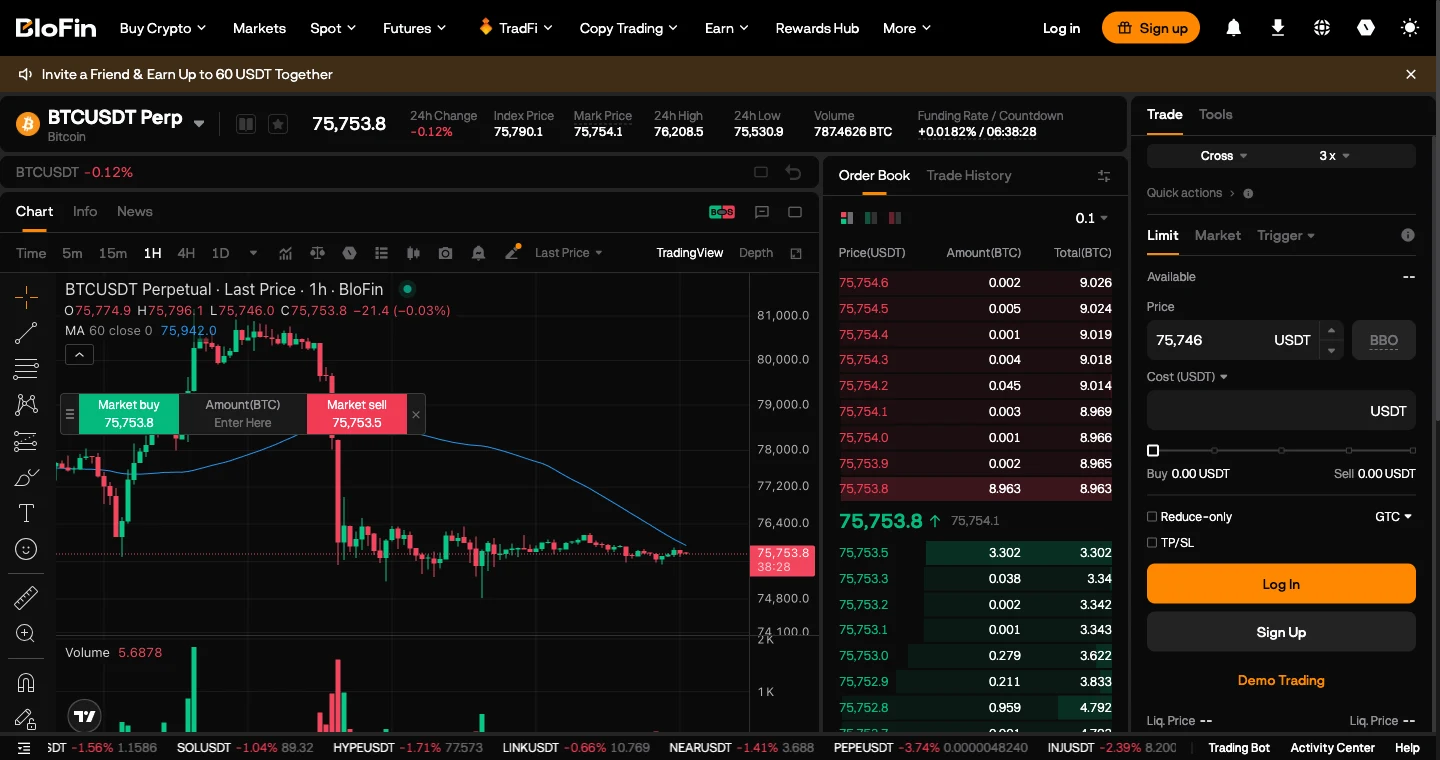
BloFin launched in 2023 and in three years assembled what takes others twice as long: by our own measurements it runs 528 perpetual contracts against USDT (504 of them serve a funding rate — that is the number you will see in our futures sections) and 504 spot pairs. The ratio tells the story — this is a futures venue, spot comes along for the ride.
It is registered in the Marshall Islands and has never issued its own token. CoinMarketCap puts it inside the top fifty by volume: around 1.3 billion dollars a day across all markets.
What is here besides plain trading
Perpetual futures are the core. USDT-margined contracts, leverage up to 125x on part of the markets, funding charged every eight hours. We collect those rates and show them in the funding section.
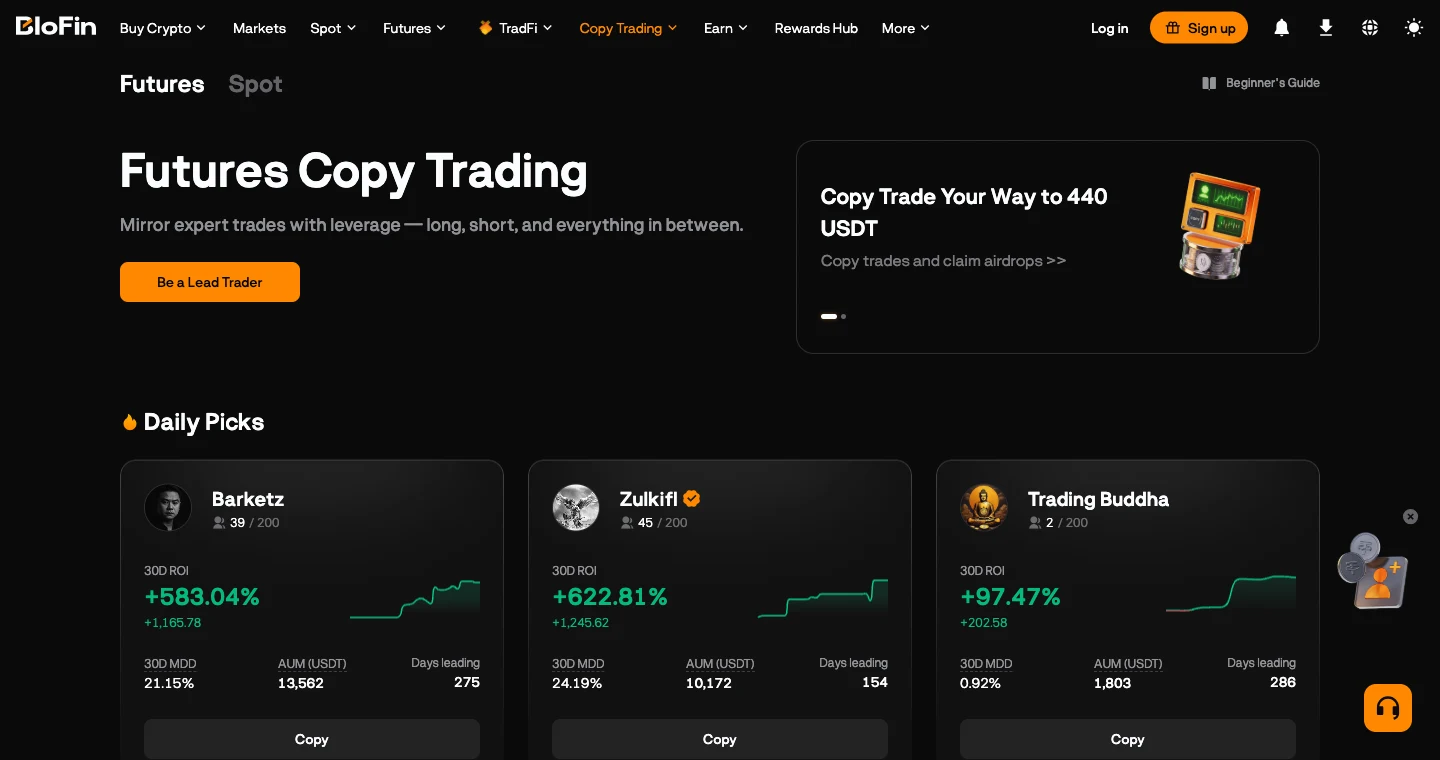
Copy trading sits in the top menu rather than in a submenu. You pick a trader, their trades are mirrored into your account, they take a cut of the profit. A tool for people who would rather not read charts — just remember that someone else’s drawdown becomes yours the same second.
TradFi is unusual for a crypto exchange: contracts on traditional markets sit next to the coins, no separate broker needed.
Earn covers flexible and fixed-term deposits.
Rewards Hub holds tasks and vouchers for new accounts. Sign up through our link and the newcomer bonuses come on top of the referral discount.
Fees: 0.02% maker on futures
A regular user pays 0.02% maker and 0.06% taker on perpetuals and 0.1% on spot. The futures rate is among the lowest in our coverage: a 100,000 USDT position costs 20 dollars as a maker against 50 on most venues.
From there the rate drops by tier, and the condition is softer than usual: a tier is granted on any one of three measures, not all of them. Either futures volume, or spot volume, or the balance on the account.
At tier one (10 million in contracts or a million in spot or 50,000 on the balance) the maker rate becomes 0.006% and the taker 0.05%. At tier five the maker rate hits zero and the taker drops to 0.035%.
How the tier is calculated
Volume is counted over thirty days and resets at 00:00 UTC, the asset snapshot is taken at the same moment, and the tiers themselves are recomputed at 01:00 UTC. Sub-accounts inherit the main account’s rate. Bonus funds and vouchers do not count towards assets — worth knowing if you planned to reach a tier on the exchange’s own gifts.
on each side of a trade
Perpetuals cost a fifth of spot: 0.02% maker and 0.06% taker.
A tier opens on futures volume, spot volume or account balance — any one of the three is enough.
Funding rates: why the venue is in our funding section
BloFin publishes rates for every contract in a single response, together with the charge interval and the time of the next settlement. Most venues do not: the rate has to be requested contract by contract, and collecting all of them in real time is impossible.
That is why BloFin takes part in funding arbitrage alongside the majors — its rates refresh in the common cycle rather than with a lag.
Deposits, withdrawals and networks
The network reference is only served to an authorised key, so we collect it separately — and we have: 503 coins with chains, deposit and withdrawal status and the transfer fee.
For USDT it looks like this: TRON — 1 USDT, Ethereum — 0.5, BNB Chain — 0.15, Polygon — 0.05, Solana — 0.5, Arbitrum — 0.2. A twentyfold difference between chains, and it is worth choosing before the withdrawal rather than after.
What the venue does not publish is contract addresses. Checking that a coin is the coin you think it is has to be done in a block explorer.
Withdraw over a network the price depends on the network
This is where most money is lost to carelessness: the transfer price depends on the network, not on the amount.
What to keep in mind
Spot liquidity on BloFin is thinner than on the top five: the pairs exist, but size moves the price. For arbitrage that means one thing — read the book, not the spread in the table. It is public and we show it in the order book tool.
One more thing: the website sometimes asks you to pass a browser check. That is bot protection rather than a block — the page opens on the second attempt.
Getting started
Registration is the usual: email, password, two-factor. Contracts are available straight away; larger withdrawals require identity verification. Open an account on BloFin ↗.
The venue's own published tariffs — BloFin
These are not our measurements but what the exchange publishes itself. Checked on November 8, 2026| Spot | maker 0.1% · taker 0.1% |
|---|---|
| Futures | maker 0.02% · taker 0.06% — a discount tier opens on any one of three measures: futures volume, spot volume or account balance |
USDT withdrawal
| Network | Minimum | Fee |
|---|---|---|
| Plasma | — | 0.012 USDT |
| Kaia | — | 0.02 USDT |
| Polygon | — | 0.05 USDT |
| Avalanche C-Chain | — | 0.1 USDT |
| BEP20 | — | 0.15 USDT |
| TON | — | 0.15 USDT |
| Optimism | — | 0.15 USDT |
| Arbitrum One | — | 0.2 USDT |
| ERC20 | — | 0.5 USDT |
| Solana | — | 0.5 USDT |
| TRC20 | — | 1 USDT |
from the exchange’s own reference, read with our key, synchronised November 8, 2026.
What the venue offers
perpetual futures with up to 125x leverage, copy trading in the top menu, Earn and contracts on traditional markets.
The legal side
the company is registered in the Marshall Islands; the venue has not issued a token of its own.
Frequently asked
How many contracts and spot pairs does BloFin have?+
By our measurements, The exchange reference lists 528 USDT perpetuals, 504 of which serve a funding rate — that is what our futures sections show. Spot pairs number 504. The figures are live: they are taken on every refresh of our market snapshot.
What are BloFin fees?+
Futures cost 0.02% maker and 0.06% taker for a regular user, spot costs 0.1%. By tier the maker rate falls to zero and the taker rate to 0.035%.
How are BloFin tiers different?+
They use "or" instead of "and": a tier is granted for futures volume, or spot volume, or the balance on the account. Most exchanges require all conditions at once.
Is BloFin part of the funding section?+
Yes. The venue returns rates for every contract in one response, with the interval and the next settlement time, so its rates refresh in the common cycle without a lag.
What are the USDT withdrawal fees?+
TRON — 1 USDT, Ethereum — 0.5, BNB Chain — 0.15, Polygon — 0.05, Solana — 0.5, Arbitrum — 0.2. We collect the full reference for 503 coins ourselves and show it in the table at the top of this page.
Methodology and principles of analytical processing
Forming and structuring the data
The analytical system brings disparate market information together into a single structure, accounting for the specifics of trading directions and the individual characteristics of each platform. That keeps the presentation consistent and the key parameters comparable.
Criteria for forming the results
Forming the analytical selection takes into account the completeness, availability and reliability of the source information. Parameters that meet the established processing and confirmation criteria are included in the calculations. Insufficiently substantiated values are not used in the final results.
Currency of the analytical information
The information presented is kept current through regular refreshing and reconciliation of the analytical parameters. How often that happens is determined by the nature of each category of data and the way it is processed.
Official sources
The exchange’s own pages — check there if our figures ever disagree with its.
- BloFin fee scheduleblofin.com
- Spot and contract tickersopenapi.blofin.com
- Batch funding ratesopenapi.blofin.com
- Networks and withdrawal feesopenapi.blofin.com
BloFin or another exchange

Binance does everything and does it on the deepest market; BloFin focuses on leveraged trading. Scale against focus.
Compare
Two derivatives terminals. The contract lists on Bybit and BloFin look alike, so details decide: fees, withdrawal networks and how the interface feels.
Compare
A terminal against an ecosystem: BloFin is stronger at trading itself, OKX at everything around it.
Compare
BloFin is built for contracts; Bitget also covers earn, bots and launches. It comes down to what you need more often.
Compare
You go to Gate for new listings and to BloFin for leverage. Picking one is rarely necessary — people keep both.
Compare
You go to MEXC for new listings and to BloFin for leverage. Picking one is rarely necessary — people keep both.
Compare
BloFin is built for contracts; KuCoin also covers earn, bots and launches. It comes down to what you need more often.
Compare
A terminal against an ecosystem: BloFin is stronger at trading itself, HTX at everything around it.
Compare
Two derivatives terminals. The contract lists on BingX and BloFin look alike, so details decide: fees, withdrawal networks and how the interface feels.
Compare
WEEX and BloFin play the same game. The difference shows up in transfer costs and in where a position is calmer to hold.
Compare
Toobit and BloFin play the same game. The difference shows up in transfer costs and in where a position is calmer to hold.
Compare
LBank collects new coins, BloFin collects leverage and contracts. Different jobs, usually done on different venues.
Compare
Kraken is good at the way in and out of real money, BloFin where leverage and contracts are needed. Not an either-or.
Compare
WhiteBIT is good at the way in and out of real money, BloFin where leverage and contracts are needed. Not an either-or.
Compare
Phemex and BloFin play the same game. The difference shows up in transfer costs and in where a position is calmer to hold.
Compare
A terminal against an ecosystem: BloFin is stronger at trading itself, XT.com at everything around it.
Compare
BloFin is built for contracts; KCEX also covers earn, bots and launches. It comes down to what you need more often.
Compare
BloFin is built for contracts; Ourbit also covers earn, bots and launches. It comes down to what you need more often.
Compare
A terminal against an ecosystem: BloFin is stronger at trading itself, BigONE at everything around it.
Compare
A terminal against an ecosystem: BloFin is stronger at trading itself, Crypto.com at everything around it.
Compare
A terminal against an ecosystem: BloFin is stronger at trading itself, Hotcoin at everything around it.
Compare
BloFin is built for contracts; Pionex also covers earn, bots and launches. It comes down to what you need more often.
Compare
BloFin is built for contracts; HIBT also covers earn, bots and launches. It comes down to what you need more often.
Compare
A terminal against an ecosystem: BloFin is stronger at trading itself, Zoomex at everything around it.
Compare
BloFin is built for contracts; Bitunix also covers earn, bots and launches. It comes down to what you need more often.
Compare
A terminal against an ecosystem: BloFin is stronger at trading itself, xRocket at everything around it.
Compare
Two derivatives terminals. The contract lists on BloFin and CoinW look alike, so details decide: fees, withdrawal networks and how the interface feels.
Compare

BloFin in our scanners: the spot spread, the futures gap, funding rates.
Other exchanges
An exchange running since 2017 that lives on futures: contract turnover here is twenty times the spot figure. Here is where it is strong and what not to expect.
Read the reviewA venue that lives on early listings: new tokens show up here before the majors notice them. Here is what it is good for in arbitrage and where its weak spot is.
Read the reviewAn exchange running since 2018 with three times more contracts than spot pairs and copy trading in the top menu. Here are its terms and how it feeds our routes.
Read the reviewThe largest crypto exchange in the world: the deepest books, the biggest P2P and a whole ecosystem in one place. Where to start and where the savings are.
Read the reviewVenue names on this page link to the exchanges through affiliate links: if you sign up through them, we earn a commission from the exchange. It changes nothing in the tables or in the review — those are collected automatically and identically for every venue.