Kraken futures in Kraken Pro: what changed
Kraken futures now live right inside Kraken Pro, as the Derivatives section of the same terminal that runs spot, margin and options. One login, one chart, one order book.
The contracts moved on too. Outside the US, every Kraken future is now linear and USD-margined: profit and loss are counted in dollars, and a single multi-collateral wallet backs them all. Coin-margined inverse contracts closed their chapter on 30 October 2026, when the last PI_XBTUSD settled at $77,468.97.
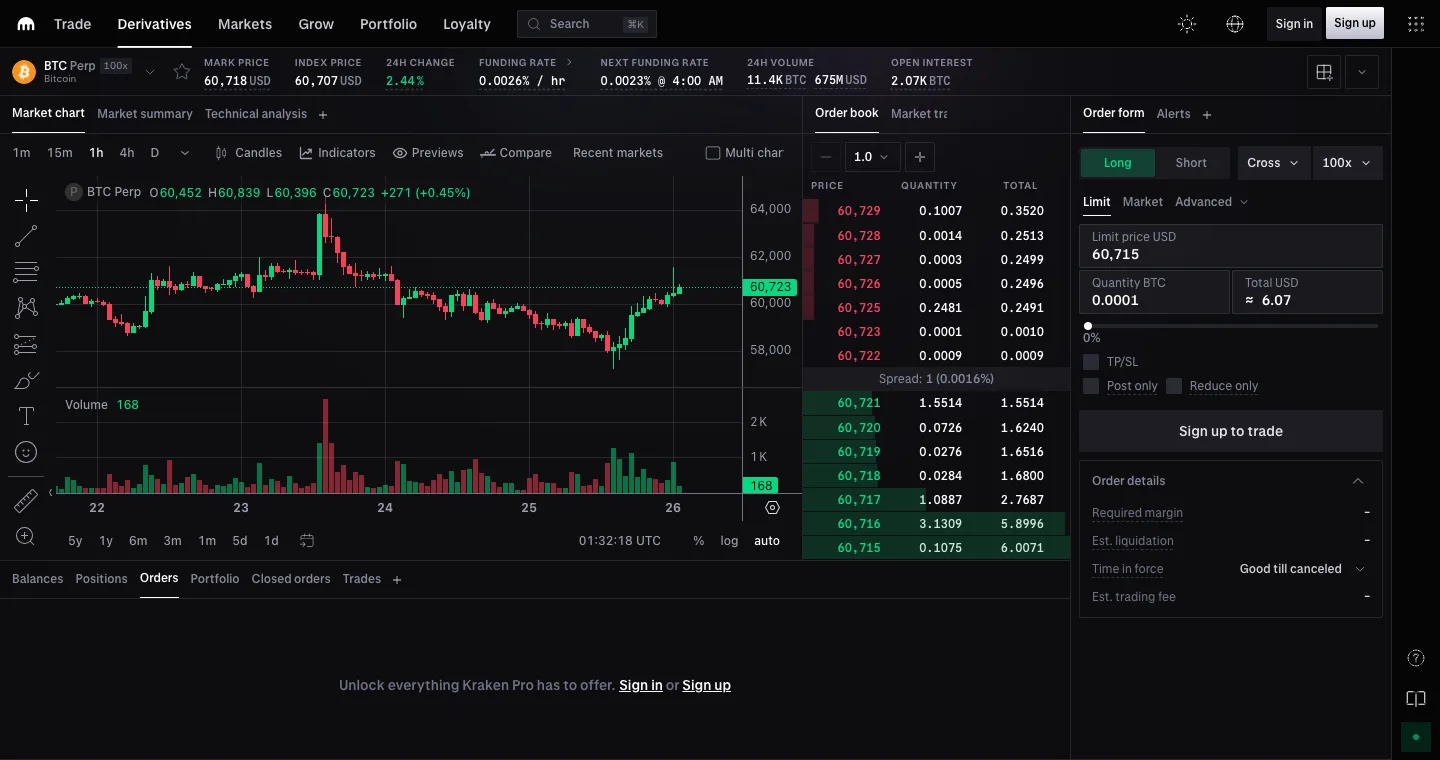
What you can trade on Kraken futures
The menu runs to 300+ contracts. Crypto perpetuals form the core, alongside gold, silver, copper, WTI and Brent crude, FX pairs, stocks and ETFs, the US100 index and xStocks tokenized equities. Trading runs around the clock, seven days a week.
Perpetual and fixed-maturity: two formats
A perpetual (prefix PF_, such as PF_XBTUSD) has no expiry and rolls itself every hour, with funding keeping its price close to spot. A fixed-maturity future (FF_) trades until a set Friday and settles in cash against an index. Kraken’s own guidance: perpetuals for longer holds and the deepest liquidity, fixed maturities for hedging or a view on a specific date.
Every trade starts with the cost of getting in and out. So that is where we start.
Kraken futures fees: fee schedule and fee tiers
0.02% to rest an order on the book, 0.05% to take liquidity. Every new account starts there, and the only way from there is down.
On a $10,000 position that is $2 as maker or $5 as taker. The fee is charged on the notional value of the filled order, which means on position size rather than on the collateral you posted.
Kraken futures maker and taker fees by tier
| Tier | Futures volume, 30 days | Maker | Taker |
|---|---|---|---|
| 1 | under $5M | 0.0200% | 0.0500% |
| 2 | $5M+ | 0.0175% | 0.0450% |
| 3 | $10M+ | 0.0150% | 0.0400% |
The first rungs of a 17-tier ladder (1–12 and Pro 1–5) for crypto and FX futures. From $100M the maker fee is 0%, from $250M makers earn a 0.0030% rebate, and the top tier pays makers 0.0060% with a 0.0125% taker fee.
One tier for spot and futures
Since 9 July 2026 Kraken Pro has used a single fee tier for spot and futures. It is set by the best of three measures: 30-day spot volume, 30-day futures volume, or assets held on the platform. Assets are measured in real time, not averaged.
The practical upshot is simple. A large balance on Kraken lifts your tier on its own, even if you trade only now and then. And active futures trading makes spot cheaper too.
An order that rests on the book first is charged the maker rate. At tier 1 that is 0.02% instead of 0.05%, two and a half times less on every trade.
How Kraken futures fees are charged
Fees are charged in USD. If your dollar balance runs short, Kraken converts other collateral for you, and USDC, USDG and USDT convert at 0%. A fixed-maturity contract held to settlement is charged at the taker rate.
You pay the trading fee once on the way in and once on the way out. Funding runs the whole time a position is open, and Kraken does it its own way.
Kraken perpetual futures funding rate: paid every hour
Most exchanges settle funding three times a day. Kraken does it twenty-four times. Funding accrues continuously as unrealised P&L and is settled at the end of each hour, or sooner if you change your position.
The rule is the familiar one. When the rate is positive, longs pay shorts; when it is negative, shorts pay longs. The money moves directly between traders, and Kraken charges nothing on funding or on the hourly roll.
How the rate is set
One day of BTC funding: 25 November 2026
Here is what that looked like in practice. The PF_XBTUSD perpetual, bitcoin at about $60,700, one UTC day. Rates are in percent per hour; amounts show what a 1 BTC long paid.
| Hours, UTC | Hourly rates, % per hour | 1 BTC long, 4 hours | Since midnight |
|---|---|---|---|
| 00–03 | 0.00149 · 0.00093 · 0.00096 · 0.00040 | $2.25 | $2.25 |
| 04–07 | 0.00102 · 0.00056 · 0.00106 · 0.00109 | $2.21 | $4.46 |
| 08–11 | 0.00083 · −0.00051 · 0.00096 · 0.00158 | $1.68 | $6.13 |
| 12–15 | 0.00100 · 0.00066 · 0.00060 · 0.00013 | $1.40 | $7.53 |
| 16–19 | −0.00038 · 0.00034 · 0.00177 · 0.00111 | $1.69 | $9.23 |
| 20–23 | 0.00123 · 0.00122 · 0.00140 · 0.00137 | $3.14 | $12.37 |
The rate turned negative at 09:00 and 16:00 UTC: in those hours longs were paid rather than paying.
What a 1 BTC long paid in one day
Over the day the rate added up to about +0.0208%. A 1 BTC long paid shorts roughly $12.37, less than half the taker fee for opening that same position, which would have been about $30.
The most expensive hour: 18:00 UTC
The most expensive hour of the day, 18:00, cost 0.00177%, more than 280 times below the cap. That is one day, not a typical value: the rate moves with the market.
Kraken funding rate in the interface and the API
Margin or futures: when each fits
Spot margin when you want the coin itself
Futures when you hold for weeks
Funding is the price of time. The price of being wrong is set by leverage and margin.
Kraken futures leverage and margin requirements
100x on bitcoin, for the first million dollars of the position. Kraken’s margin ladder treats each slice of a position separately, which keeps leverage predictable.
Outside the EEA and the US, BTC, ETH and SOL perpetuals open with up to 100x on the first band: up to $1M notional for BTC, $500k for ETH and $200k for SOL. Initial margin there is 1%, and maintenance margin is half that, 0.5%.
Kraken BTC perpetual margin schedule
| BTC position notional | Leverage | Initial margin | Maintenance |
|---|---|---|---|
| up to $1M | 100x | 1% | 0.5% |
| $1M–3M | 50x | 2% | 1% |
| $3M–5M | 25x | 4% | 2% |
| $5M–10M | 20x | 5% | 2.5% |
| $10M–30M | 10x | 10% | 5% |
| $30M–50M | 5x | 20% | 10% |
| $50M–150M | 3.33x | 30% | 15% |
| over $150M | 2x | 50% | 25% |
Margin schedule for the BTC perpetual outside the EEA and US. Maintenance margin at every band is half the initial margin.
Example: a $2M BTC position
Each band applies to its own slice, not to the whole position. A $2M position gets 100x on the first million and 50x on the second, so requirements rise smoothly rather than in one jump.
EEA: up to 10x under MiFID II
In the European Economic Area, Kraken futures run under MiFID II through a Cyprus-based Kraken entity licensed by CySEC. The first band there is 10x, with 10% initial and 5% maintenance margin, and for Class A contracts it stretches to $30M. After that come 5x, 3.33x and 2x.
Other markets
- BTC, ETH and SOL fixed-maturity futures: up to 50x.
- Gold, silver and WTI: up to 25x; copper, natural gas and Brent: up to 20x.
- xStocks perpetuals: up to 20x.
Kraken suggests a simple way to keep a buffer: add collateral or trim the position. The smaller the notional relative to collateral, the further away the liquidation price.
How do those percentages turn into an actual price? Let us run one trade.
Kraken futures liquidation price: a worked example
You have $600 in your Kraken Pro account. You open a 0.05 BTC long at 5x. To keep the arithmetic clean, bitcoin is at a round $60,000.
A 0.05 BTC long at 5x, step by step
How funding shifts the liquidation price
Funding moves that price only slightly. At the 25 November rates, a 0.05 BTC long would have paid about $0.62 for the day, lifting the liquidation price by roughly $12.
Kraken liquidation price at 2x, 5x, 10x and 50x
Now the same $600 at different leverage:
| Scenario | Position | Maintenance margin | Liquidation ≈ | Buffer |
|---|---|---|---|---|
| 2x | 0.02 BTC · $1,200 | $6 | $30,180 | −49.7% |
| 5x | 0.05 BTC · $3,000 | $15 | $48,270 | −19.5% |
| 10x | 0.1 BTC · $6,000 | $30 | $54,300 | −9.5% |
| 50x | 0.5 BTC · $30,000 | $150 | $59,130 | −1.5% |
| 5x in the EEA | 0.05 BTC · $3,000 | $150 (5%) | $50,560 | −15.7% |
$600 of USD collateral, no other positions, entry at $60,000, taker entry fee included. Maintenance margin shown at the entry price.
5x in the EEA: 5% maintenance margin
The last row shows the European schedule at work: at the same 5x, EEA maintenance margin is 5% rather than 0.5%, and the buffer is measured against it.
What happens at the threshold
Kraken runs liquidation through a transparent sequence called the Equity Protection Process. First the position is reduced in 10% steps, which is often enough to bring the account back above maintenance margin. If not, the next steps follow in order: a full close with an IOC order priced so the account stays at zero or above, assignment to registered liquidity providers, covered liquidation through the Derivatives Liquidity Pool, and unwind.
Your Kraken futures balance never goes negative
The result for the trader: the balance never goes below zero, and Kraken applies no socialised losses and no claw-backs. The process starts the moment the threshold is reached, so keep the liquidation price in view. It is always shown in the positions tab.
Mark price and your liquidation buffer
The mark price is the spot index plus the contract premium smoothed over 30 seconds and capped at 1%. Kraken measures liquidation against it, not against the last trade on the book.
Collateral in dollars or stablecoins keeps the liquidation price where you calculated it. BTC collateral moves with the position, so the buffer shifts along with the price.
Which is why what you post as collateral matters so much.
Kraken multi-collateral margin: what you can post
To trade a gold future you do not need to buy gold. You do not even need to hold dollars.
Kraken’s multi-collateral wallet accepts 50+ assets and values each one in dollars after a small haircut. Fiat carries no haircut, and BTC and ETH only 1%. Since 3 July 2026, xStocks tokenized equities count as collateral too.
Kraken collateral haircuts: fiat, stablecoins, BTC, xStocks
| Asset | Haircut |
|---|---|
| USD, EUR, GBP, CAD, AUD | 0% |
| USDT, USDC | 0.5% |
| USDG, EURC | 1% |
| BTC, ETH | 1% |
| XRP | 5% |
| SOL, ADA, DOGE, LTC, DOT | 7.5% |
| xStocks | 10–30% |
Part of the list. The full table with the haircut for each asset is in Kraken’s support article on derivatives collateral currencies.
Which currency profits and losses settle in
Profits arrive in USD by default, but you can choose to receive them in another collateral currency. Losses are booked in dollars: if USD runs short, Kraken converts other collateral automatically.
Holding part of your collateral in USD, USDC, USDG or USDT avoids conversions and the hourly charge on unrealised losses not covered by dollars. USDC, USDG and USDT convert at 0%.
Unified Wallet: one balance for everything
The Unified Wallet pools spot, margin, Earn, multi-collateral futures and options into a single balance. No more transfers between them, and unrealised profit works as margin straight away. You switch it on in settings without closing positions; in the EEA it has been available since 16 October 2026.
Cross margin and isolated margin on Kraken
Cross margin is the default, and isolated margin is available for multi-collateral contracts. You choose the mode per contract before opening a position.
In cross mode a position draws on your whole eligible balance, spot included. Isolated margin limits the trade to the collateral you assign to it.
The collateral is shared. The time horizons are not.
Kraken fixed-maturity futures: weekly to semi-annual
Every Friday at 08:00 UTC, at least one bitcoin contract expires on Kraken.
Kraken BTC, ETH and SOL expiry calendar
BTC and ETH always have four fixed-maturity contracts listed: weekly, monthly, quarterly and semi-annual. SOL has monthly and quarterly. Weeklies expire every Friday, monthlies on the last Friday of the month, and quarterlies and semi-annuals on the last Friday of March, June, September and December.
How Kraken fixed-maturity futures settle
The settlement price is the average of one-minute index values between 07:30 and 08:00 UTC, and cash arrives within 15 minutes. Leverage goes up to 50x. Holding to settlement is charged at the taker rate, and you can exit at any time before that with an opposite order.
Basis trade: perpetual against quarterly
A cross long and a cross short on the same underlying in different maturities, such as a perpetual against a quarterly, are netted for margin: the requirement is the larger of the two sides.
BTCOPTRR, ETHOPTRR and SOLOPTRR indices
Fixed-maturity futures settle against the BTCOPTRR, ETHOPTRR and SOLOPTRR indices, the same ones used by Kraken options. A future and an option on the same date rest on the same index.
That leaves one question: where is all this available?
Kraken perpetual futures in Europe and the US
Kraken builds its derivatives around each region’s rules, so the contract menu and leverage depend on where you live.
| Region | What is offered |
|---|---|
| Kraken international platform | perpetuals on crypto, FX, metals, oil, equities and xStocks; BTC, ETH and SOL fixed maturities; up to 100x on BTC, ETH and SOL — the exact cap for your country is shown in the order form |
| EEA | perpetuals and fixed maturities under MiFID II, up to 10x; TradFi futures on the CME schedule since 16 March 2026 |
| United Kingdom | for professional clients |
| Australia | for wholesale clients |
| United States | Kraken Derivatives US: CME-listed futures since July 2025 and perpetuals listed on Bitnomial since 15 June 2026 |
EEA: what to prepare
Alongside full verification you will need to complete an appropriateness questionnaire and provide a Tax Identification Number (TIN). After that, the Derivatives section opens in the same Kraken Pro.
US: perpetuals on Bitnomial
Since 23 November 2026, US perpetuals have been fractional, with minimums of 0.0001 BTC, 0.001 ETH, 0.1 SOL, 1 XRP or 100 DOGE. There are 17 contracts, available in every state except Maine and New York.
Bitnomial fees: $0.0113 per side
Fees are per contract: an all-in $0.0113 per side, covering commission, exchange and clearing, and the NFA fee.
Kraken futures for traders in Ukraine
For Ukraine, Kraken’s restriction list covers only Crimea and the Donetsk and Luhansk regions; the exchange shows the exact terms, including leverage, when you unlock derivatives. Kraken does not offer derivatives in Russia or Belarus.
If your region is open, you are five steps from your first trade.
How to start trading Kraken futures: steps, demo and API
Five steps to your first Kraken futures trade
Limit orders are accepted within 20% of the mark price, market orders fill no more than 1% beyond the best bid or ask with any remainder cancelled, and if equity falls below initial margin, open limit orders are cancelled automatically.
Kraken futures demo account: paper trading
Paper trading is part of the Kraken Pro toolkit: practice trading without real money. It is a good way to rehearse the order form and watch how the liquidation price moves before you post real collateral.
Kraken futures API
For algorithmic trading, derivatives are available through REST, WebSocket and FIX APIs (FIX since March 2025), plus a CLI and TradingView integration.
Kraken historical funding rates: CSV and API
Historical funding rates can be exported to CSV straight from the interface or pulled from the public historicalfundingrates endpoint, and the liquidation price is also streamed over WebSocket.
Kraken futures: the bottom line
Hourly funding without sudden jumps, a fee ladder that even spot activity pushes down, collateral in dozens of assets and a balance protected from going negative. Kraken Futures is a mature tool for traders who like to know their numbers before they click.
FAQ
What does “linear” mean for Kraken futures?+
Profit and loss move one-for-one with price and settle in USD or in another collateral currency you choose. Outside the US, every Kraken futures contract is linear.
Who is my counterparty?+
Another client. Kraken matches orders on the book and is not the counterparty to your positions.
What is the Kraken perpetual futures funding rate?+
A payment between longs and shorts based on the perpetual’s premium to the spot index, charged every hour. It accrues continuously, settles at the end of each hour or when you change your position, and is capped at ±0.5% per hour for standard perpetuals.
What are Kraken futures fees?+
At tier 1, 0.02% maker and 0.05% taker, falling as volume grows. The tier is shared with spot and set by the best of three measures: spot volume, futures volume or assets held on the platform.
What leverage does Kraken futures offer?+
Up to 100x on BTC, ETH and SOL on the first band of the margin schedule outside the EEA and US, and up to 10x in the EEA. Leverage steps down as the position grows.
Can my balance go negative?+
Kraken’s Equity Protection Process keeps the balance at zero or above: first a partial reduction, then a close at a price that leaves the account at zero or better. Kraken applies no socialised losses and no claw-backs.
Where can I see my liquidation price?+
In the positions tab of Kraken Pro or through the WebSocket API. It is an estimate of the mark price at which liquidation would start, and it changes with your collateral, funding and other positions.
Can I be long and short at the same time?+
Not in the same contract, which holds one net position. In different maturities on the same underlying you can, and in cross mode those positions are netted for margin.
Does Kraken have a futures demo account?+
Kraken Pro includes paper trading, practice trading without real money. It is a convenient way to rehearse orders before trading with real collateral.
What happened to Kraken inverse futures?+
The last inverse perpetuals settled on 30 October 2026, and balances left in inverse wallets after 16 November moved to the spot wallet. Outside the US, all contracts are now linear.
More Kraken products
 Spot tradingKraken Pro fees, USD and EUR pairs, order types and your first orderMargin tradingSpot with a loan: up to 10x, 20x on BTC/USD and ETH/USD, shorts, rollover every 4 hoursRollover feeThe cost of holding margin: every 4 hours, BTC and USD rates, a $10,000 worked exampleOptionsBTC and ETH options on Kraken Pro: RFQ quotes, USD settlement, portfolio marginxStocksTokenized stocks and ETFs: the Kraken app with no fee in USD, or the Kraken Pro order book with a maker rebateInstant BuyBuy, Sell and Convert in the Kraken app: one price, instant fill, 1% plus spreadKraken PropProp trading inside Kraken Pro: up to $200K, evaluations from $20Ink PointsKraken Pro loyalty points: seasons, 6 tiers, a leaderboard and the Ink chain