How Kraken margin trading works
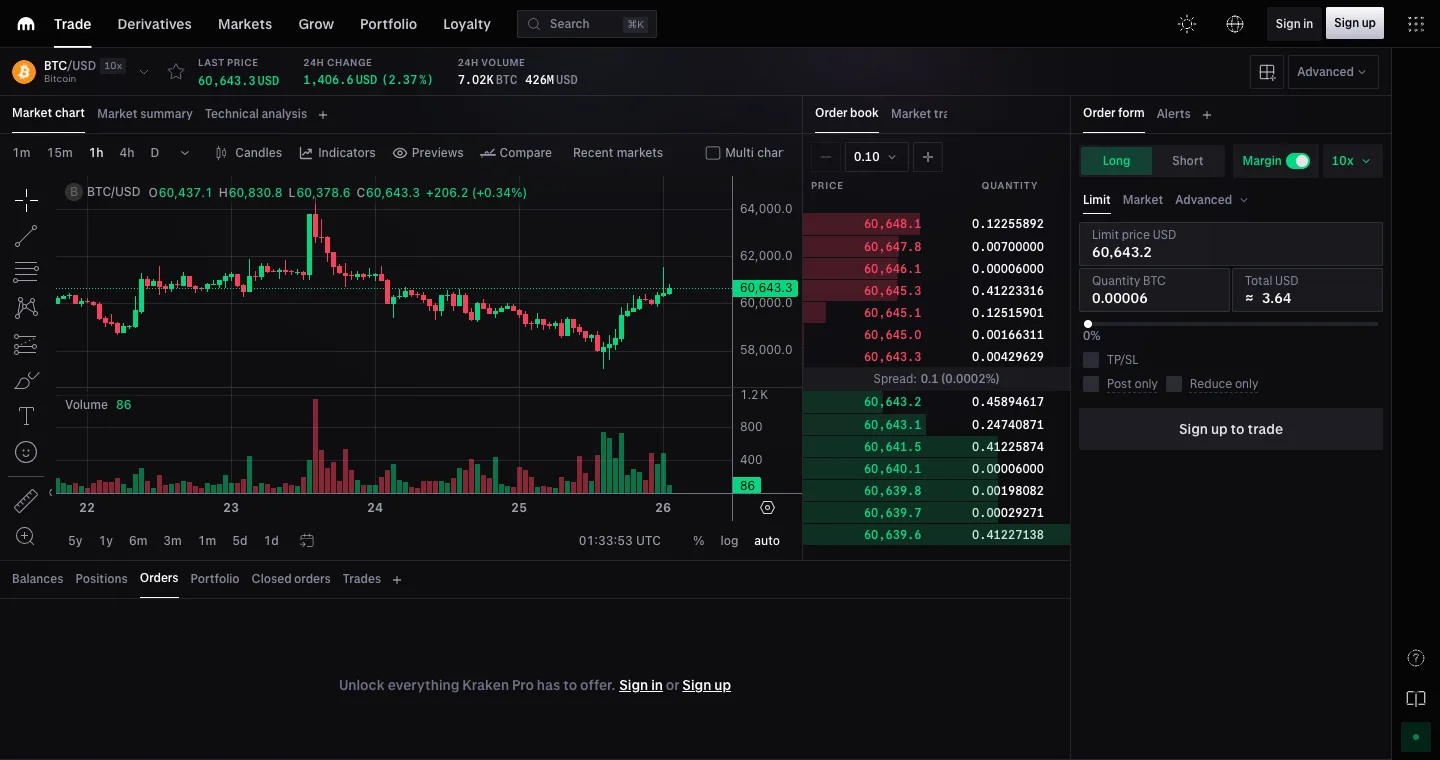
Most exchanges sell leverage as a contract: a perpetual future that tracks the price of bitcoin without ever handing you a satoshi. Kraken offers that too. Its margin product works the other way round: Kraken lends you money or coins, and you trade the real asset in the ordinary spot order book.
Go long BTC/USD and Kraken lends you dollars from its own margin pool. Go short and it lends you bitcoin, which you sell straight away. Your own assets stand behind the loan as collateral. There is no expiry, no funding exchanged between longs and shorts, no forced roll: the position lives until you close it.
The order executes in two steps, first the loan and then the trade, in the same book as spot trading on Kraken. That is why margin volume counts toward the same Kraken Pro fee tier as ordinary spot.
The Kraken Pro website and app, Kraken Desktop and the API are all home to margin. The main Kraken app is built for instant buys; the trading terminal lives in Pro.
Borrowing is the easy part. The interesting question is how far you can stretch it.
Kraken leverage: 10x on major pairs, 20x on BTC/USD and ETH/USD
Kraken's margin page says "up to 20x" in large type. Twenty times applies on the two flagship markets, BTC/USD and ETH/USD, in the countries where local regulators allow it. The rest of the line-up steps down from there.
| Market | Max leverage |
|---|---|
| BTC/USD, ETH/USD | up to 20x |
| BTC, ETH vs EUR, USDC, USDT | up to 10x |
| SOL, XRP, ADA, DOGE, LINK | up to 10x |
| LTC, AVAX, SUI | up to 10x |
| USDT and USDC stablecoin pairs | up to 10x |
| Most other pairs | 2x–5x |
| xStocks | 2x–3x |
20x on BTC/USD and ETH/USD applies in select countries. Altcoin pairs at 10x are quoted in USD, EUR and some stablecoins. The multiplier sits next to every pair in Kraken Pro.
More than 250 pairs trade on margin in total. A few newer tokens are long-only: you can buy them with leverage, and the position limits table shows which ones also take shorts.
Leverage on Kraken has one feature that surprises newcomers: on its own it does not make a position bigger. It sets how much collateral is held against the position, one fifth at 5x, and caps its maximum size. The size itself is your call. That is what the next example is about.
Margin call and liquidation on Kraken: a $1,000 long at 5x
You have $1,000 on Kraken. Bitcoin, for round numbers, trades at $100,000. You switch on Margin, pick 5x and buy 0.05 BTC, a $5,000 position. Kraken lends you the full $5,000, and your thousand stays on the balance as collateral.
From here Kraken watches one number, the margin level: equity ÷ used margin × 100%. Equity is your collateral plus unrealised profit or loss. Used margin is the position cost divided by leverage: $5,000 ÷ 5 = $1,000.
Three marks on the scale
- Above 100%: you can open new margin positions.
- Around 80%: margin call. "Around" because the exact level depends on volatility. From here Kraken may close positions to bring the level back above 100%.
- 40%: liquidation. The engine closes positions automatically and carries the process through to the end.
Where the marks fall on a 0.05 BTC long
Now the arithmetic. At entry, equity is $1,000 and used margin is $1,000, so the margin level is exactly 100%. A maximum-size position starts life right on the first mark.
A margin call needs equity to fall to $800, a $200 loss. On 0.05 BTC that is a $4,000 move: bitcoin at $96,000, just 4% below entry. Liquidation needs equity of $400, a $600 loss, a $12,000 drop to $88,000, 12% below entry.
Same 5x, half the size: a $2,500 Kraken position
Four percent is an ordinary day for bitcoin. Now take the same thousand, the same 5x and a position half the size:
| Same $1,000 at 5x | $5,000 position | $2,500 position |
|---|---|---|
| Bought | 0.05 BTC | 0.025 BTC |
| Used margin | $1,000 | $500 |
| Margin level at entry | 100% | 200% |
| Margin call (≈80%) | $96,000 (−4%) | $76,000 (−24%) |
| Liquidation (40%) | $88,000 (−12%) | $68,000 (−32%) |
Entry at $100,000, $1,000 of collateral in USD. Fees are left out so the arithmetic stays visible; they come off the balance and move both marks slightly closer.
Six times more room before a margin call
Same leverage, six times the room before a margin call. That is the practical meaning of "leverage is a ceiling, not an obligation".
Kraken liquidation price in the order form
Before you confirm, Kraken Pro shows the estimated liquidation price and borrow cost and updates them live. Kraken usually emails you at a margin call, while a stop-loss acts on its own, so that is the tool to lean on.
Two more rules of good risk management. A loss is not capped at the used margin, so the stop-loss is part of the trade rather than an add-on. And liquidation runs first in, first out: the oldest position closes first. The mirror trade, a bet on a fall, works almost the same way, with one twist.
How to short bitcoin on Kraken
To profit from a falling bitcoin on Kraken, the spot terminal is all you need. You borrow bitcoin from the Kraken pool and sell it at once; when you close, you buy it back and the loan is repaid. If the price fell in between, the difference is yours.
Kraken short example: 0.05 BTC at 5x
Take the same $1,000 and the same 5x: a short of 0.05 BTC at $100,000. Used margin is $1,000, and the marks mirror the long: a margin call near $104,000, 4% above entry, and liquidation at $112,000, 12% above.
The BTC borrow rate on a Kraken short
The twist is the loan currency. A long BTC/USD borrows dollars, a short borrows bitcoin, so the short pays the BTC rate: 0.010% per four hours against 0.025% for USD in Kraken's rate table. On a 0.05 BTC short that is 0.000005 BTC per period, about $0.50 at $100,000.
Opening and closing a short in Kraken Pro
- In Kraken Pro, Sell with the Margin toggle on opens a short.
- A Buy order with margin on the same pair, up to the position size, closes it. An order larger than the position flips you into a long.
- Collateral need not match the pair: you can short BTC/USD against euros, stablecoins or ether.
On a short the price can keep rising, which makes a stop-loss especially useful. Holding the position also has a price, and on Kraken it is charged every four hours.
Kraken margin trading fees and margin rates
A margin position on Kraken comes with a clear bill of a few lines. Two will be familiar from spot; two belong to the loan.
| Item | When | How much |
|---|---|---|
| Trading fee | entry and exit | 0.40% / 0.80% at tier 1 |
| Opening fee | once, at entry | 0.01–0.05% of the loan |
| Rollover fee | every 4 hours | same rate |
| Settle | repaying the loan | no trading fee |
| Index liquidation | if it comes to it | 2% |
Trading fee is maker / taker on the Kraken Pro schedule, falling as volume grows. A liquidation at the index price carries 2% in place of the trading fee.
Kraken margin rates: BTC, USD and other assets
The borrow rate depends on what you borrow. Bitcoin is the cheapest asset to borrow at 0.010% per period. The dollar costs 0.025%. Almost everything else, including ETH, SOL, XRP, EUR, GBP, USDT and USDC, costs 0.020%. The first rollover comes four hours after opening.
Rollover rate locked at execution
Rates move with the market, but the rollover rate is locked when your order executes and stays with that position. You see it in the order form; for an open position, click it in the Positions tab.
What the $5,000 long costs to hold
The loan is $5,000 in dollars at 0.025%: $1.25 at opening and $1.25 every four hours after that.
| Holding period | Opening + rollover |
|---|---|
| 24 hours | $8.75 |
| 7 days | $53.75 |
| 30 days | $226.25 |
Opening fee plus one rollover per four hours at a constant 0.025% on a $5,000 loan. Trading fees on entry and exit are separate.
Daily cost against your own $1,000
The rate is charged on the loan, not on the collateral. At 5x that is $7.50 a day against your own thousand: easy to carry for a trade of a few days, a line worth budgeting for over a month. Kraken margin is built for trades measured in hours and weeks.
One line of the bill you can skip entirely. Settle repays the loan with your own funds of the same asset, with no trading fee, and the bitcoin you bought stays yours, free of the loan. Which raises the question of what Kraken counts as your funds.
Kraken margin trading requirements: verification, collateral, cross margin
The bar to entry is low. A Verified account is enough, and in most countries Kraken asks for no minimum net worth for margin. All you need is at least one collateral asset on the balance.
Collateral does not have to match the pair. Hold euros and go long SOL/USD, or hold bitcoin and short ETH/USD. More than 50 assets qualify, from fiat and stablecoins to major altcoins and even tokenised gold, each counted with a discount known as a haircut.
| Collateral | Haircut | $1,000 counts as |
|---|---|---|
| USD, EUR, GBP, CAD, AUD | 0% | $1,000 |
| USDT, USDC | 0.5% | $995 |
| BTC, ETH | 1% | $990 |
| XRP | 5% | $950 |
| SOL, ADA, DOGE, LTC, DOT | 7.5% | $925 |
| Memecoins and small caps | 20–50% | $800–500 |
Kraken updates haircuts and per-asset caps; the current list is in the interface.
Collateral comes from your regular balance; coins in Kraken Pro staking keep earning separately. Collateral behind an open position stays in place until the position closes.
Cross margin: the whole balance works together
Kraken spot margin runs in cross mode. Your entire balance is one shared pool of collateral for every margin position: a winning trade supports a losing one, and the engine compares total equity against total maintenance margin. It is capital-efficient and well suited to hedges and paired trades.
Since the whole balance is the collateral, a liquidation draws on the whole Kraken balance too, and Kraken says so plainly. That is why each position gets a stop-loss, a trailing stop or an OCO order. If a liquidation does happen, the engine closes just as much as the account needs. Isolated margin on Kraken is available on derivatives.
The rules on who can borrow what depend on the country, and the details matter.
Kraken margin trading in the USA, Canada, UK and Germany
In Kraken's own words, margin is open to most verified clients outside the US, the UK, Canada and Australia. Each of those four has its own set-up.
| Where | How it works |
|---|---|
| Most countries | verified clients |
| USA | retail via Kraken Derivatives US, up to 10x |
| Germany and the EEA | fiat pairs funded with USDC and EURC |
| United Kingdom | fiat loans under FCA conditions |
| Australia | fiat loans after the TMD test |
| Canada | spot margin outside the Canadian line-up |
Kraken margin trading in the USA
Since 6 May 2026, spot margin on Kraken Pro has been open to eligible US retail clients. The product runs through Kraken Derivatives US under CFTC oversight, with leverage of up to 10x. The order form shows an estimated borrow cost per day, charged every four hours at a rate locked on entry.
Eligible contract participants on Kraken
Clients who self-certify as eligible contract participants, which for an individual means more than $10 million in investments under their own management, get the full international product.
Kraken margin by US state
Kraken serves US clients outside Maine and New York, and residents of Texas and New Hampshire trade margin outside the EUR order books.
Germany and the rest of the EEA
Margin is available. Since January 2026, margin on fiat pairs has been funded with stablecoins: USD pairs with USDC, EUR pairs with EURC, converted 1:1 with no fee. Margin markets for the EEA are the USD and EUR pairs, and the stablecoins in use there are USDC and EURC.
United Kingdom
Loans in fiat and fiat-backed stablecoins are open to clients who declare high-net-worth status, meaning net income above £150,000 or net assets above £500,000 confirmed by an accountant, or who use margin for business purposes. Crypto-to-crypto margin and crypto/fiat shorts are open to everyone.
FCA questionnaire and 24-hour cooling-off
Retail clients complete the FCA appropriateness questionnaire, and new accounts get a 24-hour cooling-off period. Kraken's UK page quotes leverage of up to 10x.
Australia and Canada
In Australia, fiat loans open after the Target Market Determination test right in the Kraken Pro order form, or for wholesale investors with net assets from AUD 2.5 million or income from AUD 250,000 two years running. Crypto loans need no extra step. In Canada, spot margin sits outside the Kraken line-up.
For any country, the quickest check is the account settings, which show whether margin is switched on for you. Once that is settled, the trade itself takes about a minute.
Kraken margin trading tutorial: open, close and settle
Two ways out of a position
Close with a trade
Settle with your own funds
Opening a margin position debits only fees from your balance. What you bought on margin shows under Positions until you close or settle. Several positions on one pair close in turn, oldest first.
That leaves one last question: is spot margin the right tool for your idea, or would a contract fit better?
Kraken margin or futures: which fits your trade
Spot margin is for traders who want the asset itself. On a long you hold real bitcoin, on a short you sell real borrowed bitcoin, and with settle you can repay the loan and keep the coin. Every cost is known before entry, and the rollover rate is locked.
If you want isolated margin for each position, or plan to hold a trade for many weeks, look at Kraken Futures: perpetual contracts with funding in place of the four-hour rollover. Both live in the same Kraken Pro account, one click apart.
For a trade of hours or weeks, on a market you would happily own, Kraken margin is a transparent way to add leverage: one account, one order book, and every number in view before you press the button.
FAQ
Does Kraken offer margin trading?+
Yes, on Kraken Pro, Kraken Desktop and the API. Kraken lends money or coins from its own pool, you trade the real asset in the spot order book, and your balance serves as collateral. You can go long or short.
What leverage does Kraken offer?+
Up to 10x on major pairs and up to 20x on BTC/USD and ETH/USD in countries where it is permitted. Most other pairs offer 2x to 5x, and xStocks 2x to 3x.
What are Kraken margin trading fees?+
The usual maker or taker fee on each trade, an opening fee on the loan and a rollover fee every four hours at the same rate. Settling a position with your own funds carries no trading fee; a liquidation at the index price costs 2%.
At what level does Kraken issue a margin call?+
A margin call comes at a margin level of about 80% and liquidation at 40%. Margin level is equity divided by used margin. New margin positions open while the level is above 100%.
How do I move my liquidation price further away?+
Add collateral, close part of the position, lower the leverage or set a stop-loss. The estimated liquidation price is shown in the order form before you confirm and in the summary of the open position.
What can I use as collateral?+
More than 50 assets, including fiat, stablecoins, BTC, ETH, SOL and XRP, each with its own haircut. Collateral does not have to match the pair you trade.
Is Kraken margin isolated or cross?+
Spot margin is cross: the whole balance is shared collateral for all positions, so profit on one supports another. Isolated margin on Kraken is available on derivatives.
Why did my balances not change after I opened a position?+
Assets bought on margin appear under Positions rather than Balances until you close or settle. Only fees are debited from the balance.
My order was cancelled for insufficient margin. What now?+
It means the Kraken lending pool in that currency is temporarily used up. Try again later, pick a pair with a different quote currency, such as BTC/EUR instead of BTC/USD, or use futures. It never stops you from closing a position.
Is Kraken margin trading available in Canada and the USA?+
In the US, yes, for eligible retail clients through Kraken Derivatives US, at up to 10x. In Canada, spot margin sits outside the Kraken line-up. In the UK and Australia, borrowing fiat comes with extra conditions.
More Kraken products
 Spot tradingKraken Pro fees, USD and EUR pairs, order types and your first orderRollover feeThe cost of holding margin: every 4 hours, BTC and USD rates, a $10,000 worked exampleKraken FuturesPerpetual and fixed-maturity contracts in Kraken Pro: fees, funding, leverage, marginOptionsBTC and ETH options on Kraken Pro: RFQ quotes, USD settlement, portfolio marginxStocksTokenized stocks and ETFs: the Kraken app with no fee in USD, or the Kraken Pro order book with a maker rebateInstant BuyBuy, Sell and Convert in the Kraken app: one price, instant fill, 1% plus spreadKraken PropProp trading inside Kraken Pro: up to $200K, evaluations from $20Ink PointsKraken Pro loyalty points: seasons, 6 tiers, a leaderboard and the Ink chain