
Networks, fees and status
Collected straight from the exchange. The fee is quoted in the coin itself and does not depend on the amount — splitting a withdrawal into parts only costs more.
What WEEX is
WEEX has run since 2018 and is registered in Singapore. People come here for futures — there are over a thousand perpetual contracts — and for honesty in the small print.
WEEX publishes the fee right in its instrument reference, pair by pair. No digging through a help section.
A thousand-bitcoin reserve whose addresses you can check on-chain yourself.
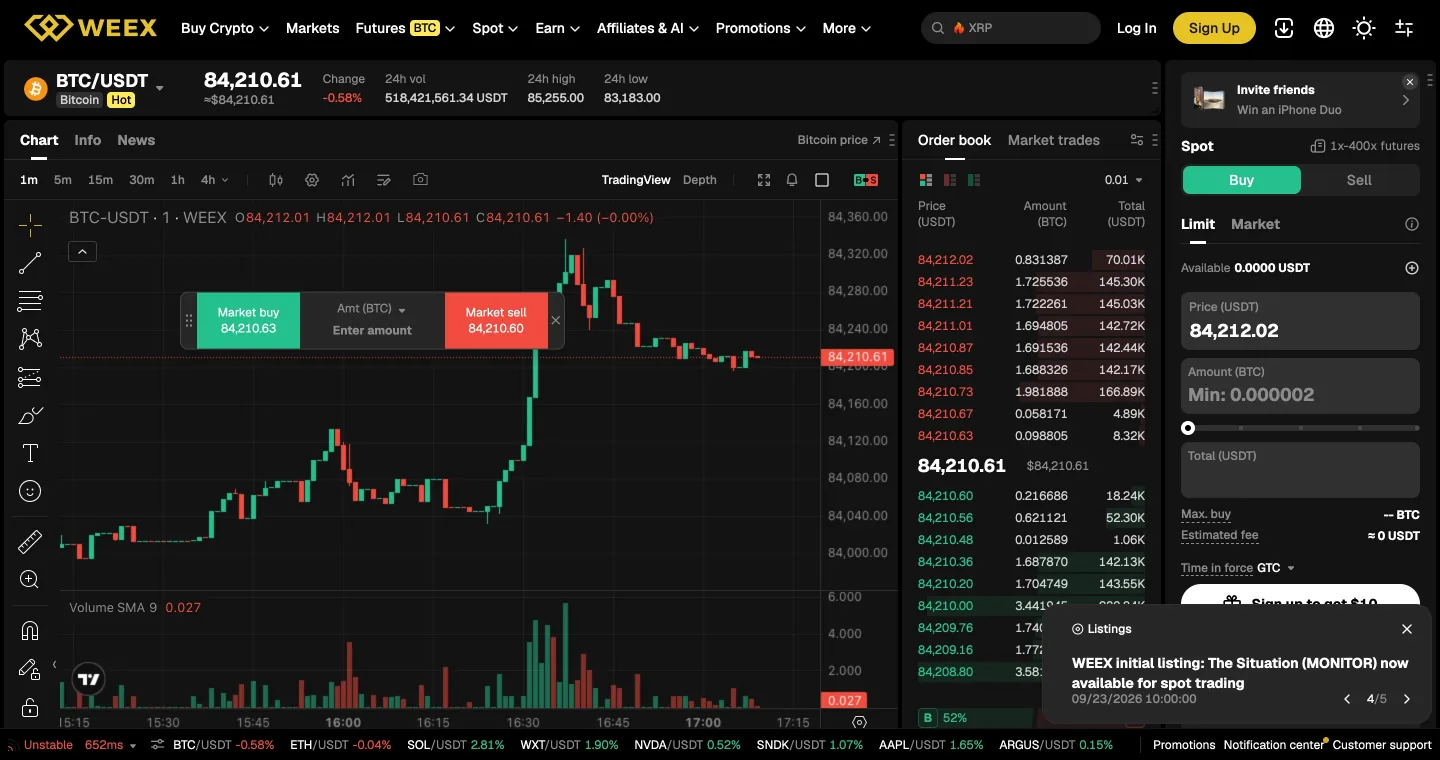
What else is here beyond plain trading
Futures are the main course; everything else sits around them.
Buying one coin for another or for USDT: plain trading, no leverage and no expiry.
1,587 pairsLeveraged contracts with no expiry date. Funding is charged every few hours — you either pay it or receive it.
1,042 contractsBuying crypto for ordinary money straight from people; the venue holds the coins in escrow until payment is confirmed.
89 currenciesYield on coins that just sit there: flexible, withdrawable at any moment, or locked for a term at a higher rate.
Mirroring a chosen trader's deals: their statistics are public and the position size scales to your capital.
A flat rate and a fund you can verify
Spot · maker = taker
0.1%One rate for both sides — flat and predictable. Volume discounts exist, but the scale is calm, with no elaborate tiers.
Protection fund
1,000 BTCA public reserve fund. Its addresses are open — you can check the balance on-chain yourself.
What you can verify yourself
- A pair's rate in the WEEX instrument reference
- The fund, via its published addresses in a block explorer
What the fund does not replace
- A full audit of the exchange
- Your own caution about size
The habit of "withdrawing via TRON" costs the most here
Many people pick TRON out of habit, as the "cheap" network. On WEEX it is the dearest of the lot — layer-two networks come out dozens of times better.
Deposits and withdrawals
The simplest way in is P2P: pick an offer, pay the seller by card, and they release the crypto from escrow. While the trade runs the coins stay frozen and the exchange holds them.
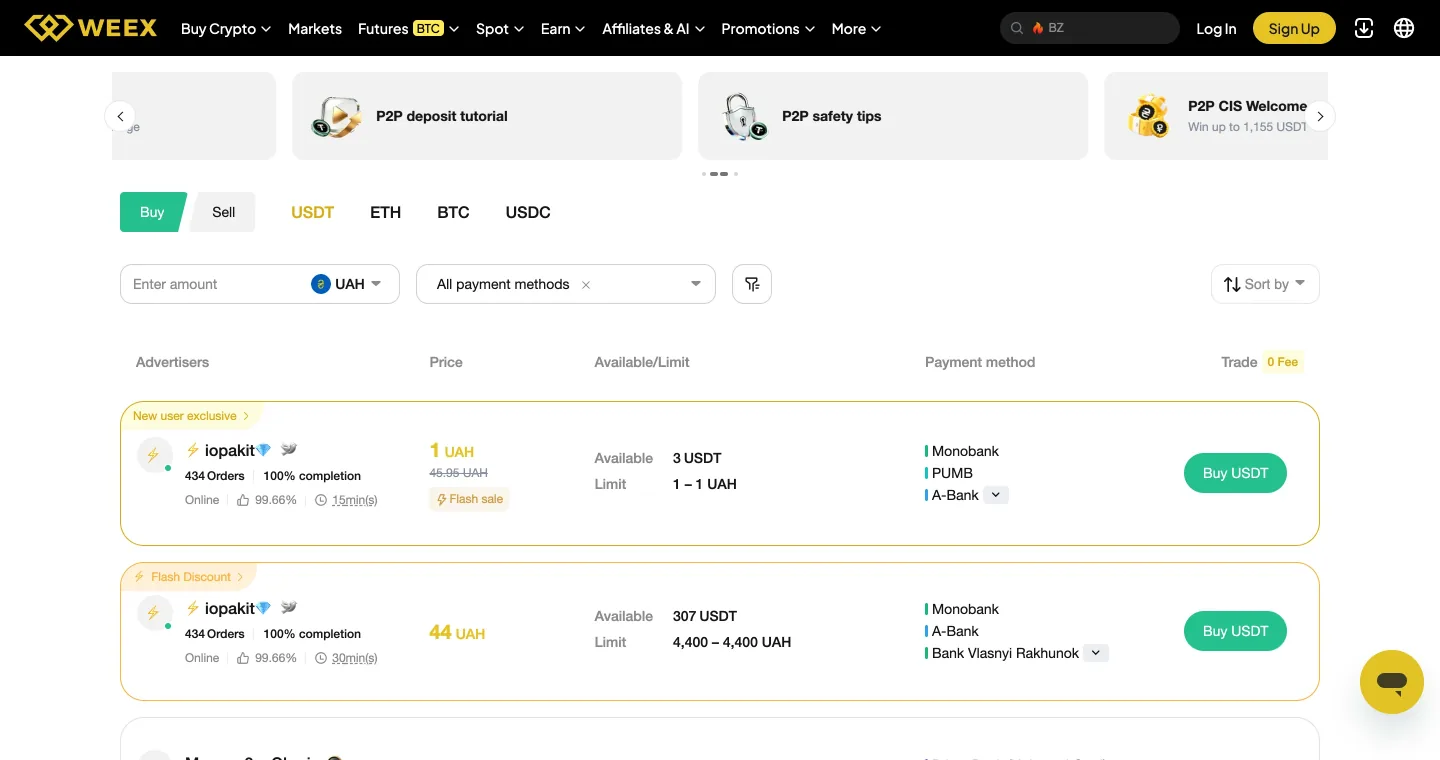
Fund through P2P the usual way in
Withdraw over a network the price depends on the network
This is where most money is lost to carelessness: the transfer price depends on the network, not on the amount.
Nine tiers, and three ways to reach them
The base spot rate is 0.10% both ways, falling to 0.005% maker and 0.018% taker at the top tier.
| Tier | Maker | Taker | Makeron contracts | Takeron contracts |
|---|---|---|---|---|
| VIP 0 | 0.1% | 0.1% | 0.02% | 0.08% |
| VIP 1 | 0.08% | 0.09% | 0.02% | 0.075% |
| VIP 2 | 0.07% | 0.08% | 0.018% | 0.06% |
| VIP 3 | 0.05% | 0.06% | 0.018% | 0.055% |
| VIP 4 | 0.04% | 0.05% | 0.016% | 0.05% |
| VIP 5 | 0.03% | 0.04% | 0.016% | 0.048% |
| VIP 6 | 0.02% | 0.03% | 0.014% | 0.045% |
| VIP 7 | 0.01% | 0.02% | 0.012% | 0.042% |
| VIP 8 | 0.005% | 0.018% | 0.01% | 0.04% |
Rates as published by the exchange on the check date; the tier is recalculated automatically. The first two columns are spot and the last two perpetual contracts. A tier is granted on volume, the WXT balance or average asset value — one condition suffices.
On contracts the maker fee is cheaper and the taker noticeably dearer: 0.02% against 0.08% at tier zero, reaching 0.010% and 0.040% by the eighth. A 10,000 USDT position costs 2 USDT as maker and 8 as taker — and the fee applies on open, on close and on partially reducing a position.
Either 30-day volume, or a WXT balance held for a day, or the average asset value over five days — one is enough. Tier one on spot takes $500,000 of volume, or 5,000 WXT, or $10,000 of assets. On contracts the volume thresholds are twice as high while the WXT and asset requirements stay the same, so for a token holder the path is shorter.
One detail about the maths: the contract fee is charged on the position's notional value, not on the margin posted. At the same notional it is identical whether the leverage is 5x or 100x — leverage changes the risk, not the cost of the trade.
Leverage to 400x — but only on the first step
The venue publishes a risk ladder for each contract, and this is a case where reading it before the trade pays. Here is how it looks for the gold contract.
| Step | Position size | Leverage | Maintenance margin |
|---|---|---|---|
| 1 | up to 50,000 USDT | 400x | 0.15% |
| 2 | up to 100,000 | 100x | 0.50% |
| 3 | up to 500,000 | 50x | 1.00% |
| 4 | up to 1,500,000 | 20x | 2.50% |
| 5 | up to 1,600,000 | 10x | 5.00% |
| 6 | up to 12,500,000 | 1x | 50.00% |
The ladder for the XAUT contract after the adjustment of 28 October 2026. Other contracts have their own steps: the same notice caps 1000XEC and FIL at 75x.
Four hundred times is available while the position stays under 50,000 USDT. On the next step the ceiling drops fourfold, and by the sixth it falls to one. The maintenance margin rises along the way: from 0.15% to 50%. For a large position that means liquidation maths quite different from the number on the banner.
The venue regularly publishes notices changing maximum leverage, position limits, maintenance margin and risk steps — worth re-reading before returning to a strategy.
Contracts
The interface documentation carries two types: ordinary perpetuals and a separate TradFi perpetual type. They are different markets and should not be stored together. Funding is counted separately from the trading fee under the contract's rules.
P2P: no fee, and the hryvnia on the list
The platform fee on P2P is zero on both buying and selling. Costs arise only with the bank or the payment system. P2P requires completed verification; the seller's coin is held by the venue until the trade closes.
WEEX has officially launched hryvnia support in P2P. USDT, BTC, ETH and USDC can be bought with it. Payment methods are added in the P2P user centre, and the set available depends on the country tied to your verification.
P2P orders have no platform-wide minimum: the advertiser sets the bounds. If the screen says there are no matching ads, it means exactly that — nobody is quoting your amount and payment method right now, not that the currency is unsupported.
The WXT token, copy trading and bots
WXT does not work as a direct per-trade discount but as one of three routes to a VIP tier: its balance counts in the table alongside volume and assets. The venue promises no fixed discount for holding the token — the effect runs through status.
Copy trading, trading bots and Earn products run separately, as does a public protection fund held in bitcoin, which the venue presents as its own guarantee over client funds.
We use the exchange's own formula: amount × rate ÷ 365 × term. Put in the rate you see in your account — it changes.
Who it suits
A transparent rate with no surprises.
A fund you can check for yourself.
Here the choice of network saves more than the trading rate.
A similar venue is Toobit: two young exchanges leaning on derivatives. Compare →
Frequently asked
What does trading on WEEX cost?+
Spot is 0.10% both ways at tier zero, down to 0.005% maker and 0.018% taker at the eighth. Contracts start at 0.02% maker and 0.08% taker and reach 0.010% and 0.040% at the top.
How is a VIP tier reached on WEEX?+
Meeting one of three conditions is enough: 30-day volume, a WXT balance held for a day, or average asset value over five days. Tier one on spot takes $500,000 of volume, or 5,000 WXT, or $10,000 of assets.
Is it true that WEEX offers 400x leverage?+
Yes, but only on the first risk step. On the gold contract 400x holds up to a 50,000 USDT position; beyond that the ceiling falls to 100x, 50x, 20x and 10x while the maintenance margin rises from 0.15% to 50%.
Can crypto be bought with hryvnia?+
Yes. WEEX has officially launched hryvnia support in P2P, covering USDT, BTC, ETH and USDC. The platform fee on a P2P trade is zero; costs arise only with the bank or payment system.
Does leverage change the fee?+
No. The contract fee is charged on the position notional rather than the margin posted: at the same notional it is identical at 5x and at 100x.
What does WEEX charge?+
0.1% for both maker and taker on spot. The exchange publishes the rate for every pair in its instrument reference, so you can check it yourself.
What is the protection fund?+
A public thousand-bitcoin reserve. Its addresses are published and the balance can be checked on-chain. It is not a full audit of the exchange.
Which network should I withdraw on?+
Not TRON — it is the dearest here. Layer-two networks are the cheapest, and live prices for each sit in the table at the top of this page.
What does the WXT token give me?+
Fee discounts and access to the exchange programmes.
Methodology and principles of analytical processing
Forming and structuring the data
The analytical system brings disparate market information together into a single structure, accounting for the specifics of trading directions and the individual characteristics of each platform. That keeps the presentation consistent and the key parameters comparable.
Criteria for forming the results
Forming the analytical selection takes into account the completeness, availability and reliability of the source information. Parameters that meet the established processing and confirmation criteria are included in the calculations. Insufficiently substantiated values are not used in the final results.
Currency of the analytical information
The information presented is kept current through regular refreshing and reconciliation of the analytical parameters. How often that happens is determined by the nature of each category of data and the way it is processed.
WEEX or another exchange


A mature derivatives venue against a younger, more flexible one. A look at what each one offers.
Compare
These two venues solve different problems, and choosing between them is really choosing how your money gets into crypto. On WEEX that means other people’s ads in almost ninety currencies; on Kraken, a transfer straight from your bank.
Compare
An all-rounder against a terminal: Binance has the deeper book and wider service set, WEEX the smoother contract trading.
Compare
WEEX is built for contracts; OKX also covers earn, bots and launches. It comes down to what you need more often.
Compare
A terminal against an ecosystem: WEEX is stronger at trading itself, Bitget at everything around it.
Compare
Gate collects new coins, WEEX collects leverage and contracts. Different jobs, usually done on different venues.
Compare
MEXC collects new coins, WEEX collects leverage and contracts. Different jobs, usually done on different venues.
Compare
A terminal against an ecosystem: WEEX is stronger at trading itself, KuCoin at everything around it.
Compare
WEEX is built for contracts; HTX also covers earn, bots and launches. It comes down to what you need more often.
Compare
BingX and WEEX play the same game. The difference shows up in transfer costs and in where a position is calmer to hold.
Compare
You go to LBank for new listings and to WEEX for leverage. Picking one is rarely necessary — people keep both.
Compare
Money goes in through WhiteBIT, trading happens on WEEX. The pair works better than picking one.
Compare
Two derivatives terminals. The contract lists on WEEX and Phemex look alike, so details decide: fees, withdrawal networks and how the interface feels.
Compare
WEEX is built for contracts; XT.com also covers earn, bots and launches. It comes down to what you need more often.
Compare
A terminal against an ecosystem: WEEX is stronger at trading itself, KCEX at everything around it.
Compare
A terminal against an ecosystem: WEEX is stronger at trading itself, Ourbit at everything around it.
Compare
WEEX is built for contracts; BigONE also covers earn, bots and launches. It comes down to what you need more often.
Compare
WEEX is built for contracts; Crypto.com also covers earn, bots and launches. It comes down to what you need more often.
Compare
WEEX is built for contracts; Hotcoin also covers earn, bots and launches. It comes down to what you need more often.
Compare
A terminal against an ecosystem: WEEX is stronger at trading itself, Pionex at everything around it.
Compare
A terminal against an ecosystem: WEEX is stronger at trading itself, HIBT at everything around it.
Compare
WEEX is built for contracts; Zoomex also covers earn, bots and launches. It comes down to what you need more often.
Compare
A terminal against an ecosystem: WEEX is stronger at trading itself, Bitunix at everything around it.
Compare
WEEX is built for contracts; xRocket also covers earn, bots and launches. It comes down to what you need more often.
Compare
WEEX and BloFin play the same game. The difference shows up in transfer costs and in where a position is calmer to hold.
Compare
WEEX and CoinW play the same game. The difference shows up in transfer costs and in where a position is calmer to hold.
Compare

WEEX in our scanners: the spot spread, the futures gap, funding rates, P2P rates.
Other exchanges
The youngest venue in our review. What people come here for is the exact funding time on every contract.
Read the reviewRunning since 2015, with early listings as its signature: new coins often appear here before they reach the large venues.
Read the reviewOne of the oldest exchanges in the world and one of the few quoting in real bank dollars rather than a stablecoin. Running since 2011 under US regulation.
Read the reviewA European exchange with Ukrainian roots: direct euro and hryvnia pairs with no USDT in between, a flat fee and its own WBT token near the top of the market.
Read the reviewVenue names on this page link to the exchanges through affiliate links: if you sign up through them, we earn a commission from the exchange. It changes nothing in the tables or in the review — those are collected automatically and identically for every venue.